Paradoxography at Dura? Miracles and Natural Wonders in the Paintings of the Synagogue
Newman Institute, Uppsala
This article attempts a paradoxographical interpretation of some of the subjects chosen for and extant in the paintings of the third-century synagogue at Dura Europos, Syria. It focuses on the miracle stories in the Elijah cycle and in the Moses cycle, the latter through the drama of Ezekiel the Tragedian. A specific category that emerges from the latter’s Exagoge is that of natural wonders, including the Burning Bush and the Springs of the Oasis at Elim, also included in the iconography. In the concluding discussion, I relate the paradoxographical interest at Dura to a fragment of Herodotos found among the Dura papyri and to the ancient practice of theoria, i.e. a journey to a destination to see special spectacles and learn about other cultures. This pilgrimage-like activity may explain the attractiveness of Dura in the late Roman period and its economic flourishing. In this climate, images advertised these activities and allowed visitors to permanently enjoy events even after their live performances. Both paradoxography and theoria are helpful concepts in understanding Dura’s iconography and in comparing it with the (probably later) mosaics at Huqoq.
In a book entitled, somewhat misleadingly, The New Testament among the Writings of Antiquity, Detlev Dormeyer considers the formal dependence between Hellenistic and Jewish writings.1 Following an established trend in scholarship akin to the present project on paradoxography, Dormeyer contextualizes the New Testament texts in the written culture of their times, but the result of this text-driven operation highlights in fact how it is the oral aspects of these particular narrative forms that best explain those relations and sought-after dependencies. Particularly relevant for the present purposes is Dormeyer’s examination of the Hellenistic derivation of miraculous accounts in the Bible. He categorizes the genre of miracle stories among the “oral apostolic narrative genres,” by which he means that they exhibited the traditional way folk stories were told and transmitted in the apostolic age, thereby including modes of speech with an aspect of visualization, such as parables, metaphors, and theophanies.2 Dormeyer notes that the narratives of Exodus and the prophets Elijah and Elisha in Kings show a concentration of the miraculous.3
Dormeyer’s observation finds immediate echo in the illustrative repertoire of the famous third-century murals of the synagogue at Dura Europos, a Syrian town on the Euphrates where Hellenistic and Jewish cultures met and integrated in an intense and harmonious multicultural environment under Roman rule.4 In this paper, I test Monika Amsler’s thesis on the impact of paradoxography on Jewish visual culture, which she develops for the synagogue mosaics at Huqoq, by applying this criterion to the wall paintings in the Dura synagogue as an earlier, Babylonian example of a similar type of attitude and activities in synagogal communities during the late Roman Empire.5 At the end of the article I will attempt a brief direct comparison between these two monuments.
My aim is not to offer paradoxography as the only key for unifying the discourse of the various panels, but rather, through select examples, to probe the likelihood of a relationship between Hellenistic uses of paradoxography and the purpose of the Dura synagogue’s paintings. In particular, I am interested in the question of how, if applicable at Dura, the paradoxographical connection could mesh with and ideally further my main thesis about the origins of these paintings in oral-performative traditions related to theatrical culture.6 Starting from the painting cycles of Elijah and of Moses,7 I will use the metrical fragments of Jewish playwright Ezekiel the Tragedian to flesh out the broader tradition of Hellenistic thaumata to which the visuality of these panels refers.8 This perspective deepens the scope of the connection between the Jewish aspects of the decorations of this meeting room and the Hellenistic-Roman context within which those decorations were executed, in line with recent studies of the murals as partaking of the Roman koine of wall-painting.9 The paradoxographical interest in this locality is finally demonstrated through the Dura papyrus of Herodotus, containing one such marvelous occurrence. I argue that the Herodotean spirit reveals the attitude to thauma found in the panel paintings more significantly than their adherence to a more rigid paradoxographical tradition.10
The basic problems of interpretation of the Dura synagogue murals revolve around the discrepancies that the iconographies show with respect to the biblical text from which they are thought to derive. Moreover, the piecemeal arrangement of the single panels does not work to reconstruct sequential narratives as expected from the biblical order of books. These points were sharply raised by Annabel Wharton.11 Her criticism of previous approaches has had an impact in subsequent scholarship, yet her conclusions do not seem to be fully accepted because they result in a radical disorientation. Commentators share a sense that paintings of this scale and sophistication should serve some purpose manifested in the order of scenes, which its randomness fails to satisfy. They thus attempt to find alternative explanations for their current planning.12 On the contrary, Rachel Hachlili fully supports Wharton. She maintains that the thematic lack of coherence of adjacent panels was in fact the sought-out effect. Such negative planning resulted in an intentional disconnectedness aimed at complying with aniconic requirements by diminishing the cultic value of the images and preserving their viewers from the dangers of idolatry. Hachlili states: “Each panel narrates a story that bears no thematic relation to the adjacent panels, ... Apparently, the formalism of the paintings and their repetitiveness made them acceptable to the Dura Jewish community.”13
Hachlili considers random juxtaposition a formal aesthetic choice designed to divorce visual narrative from its representational task, making each scene somewhat abstract and symbolic despite its figural appearance. In Hachlili’s view the community suffered the visuality of these paintings more than it willed and embraced it. This disconcerting analysis may still be telling of the difficult adjustment of a religious system considered aniconic to historical instantiations of figurative art, despite the burgeoning literature on Jewish art, created almost ex nihilo as a worthy academic subject by a cohort of scholars engaged in the new discipline.14 Hachlili’s position demonstrates continued reluctance to accept figural evidence even from the Babylonian periphery where Dura was situated. By considering the panels’ disconnectedness as the condition for the paintings’ acceptance by an otherwise visually disinclined community, the community itself is perceived or presumed to be in perfect continuity with an axiomatically aniconic faith tradition.15
Among the theological or ideological explanations given for coherent readings of these panels, an interest in and adherence to paradoxography has not so far featured.16 Even if the principle of paradoxography should fail to unite all panels at Dura in a single thematic frame, it is worth exploring how far this approach could provide an alternative or at least an additional criterion informing the depictions, thereby subtracting them from purely arbitrary and formalistic principles. Formulating a basis for a concerted, positive purpose in the choice of subject-matter for the panels while maintaining Wharton’s correct observations on the disconnected character of these representations becomes urgent in order to restore an active and participatory iconicity to this place and its community and thereby counteract Hachlili’s move to explain all that away.
The Hellenistic tradition of paradoxography is considered a purely literary endeavor producing anthological works on various apt topics exhibiting thaumata and was essentially fueled by people’s taste for the marvelous.17 While the context of ancient paradoxography is undoubtedly relevant to the analysis of the paintings, as we shall seek to demonstrate, the reason for the presence of thaumata falls more easily within the philosophical compass of paradoxographical knowledge, as outlined by Jessica Lightfoot, than towards the compilers’ more mechanical activities of listing and cataloguing as many odd phenomena as were available in the written sources.18 Lightfoot points out two very important aspects of the genre: its strong bond to the divine as the implied cause of any extraordinary event,19 and its theatrical aspect (thaumatopoiia) expressed in remarkably visual terms that opened it up to Platonic criticism as a light and misleading form of entertainment.20 Both these aspects are appropriately reflected in the miraculous narratives chosen for the painting programme. The elision of a religious discourse of miracles with the established repertoire of paradoxographical knowledge proceeds from a philosophical attitude of openness to wonder and “belief” which, while encompassing both cognitive mental faculties and emotions,21 is not for this devoid of a skeptical outlook and maintains a sharp consciousness of human limitations.22 As the genre demands, wondrous things are presented as if they were real.23 Through this willing suspension of disbelief, the audience accesses the full enjoyment of the spectacle of the marvelous. At the same time, the audience keeps awareness of the narrative modality at play, so that it can both fully participate in the enjoyment of the thauma and critically assess its contents while preserving, and indeed forming, its faculties of discernment. This process is indeed “thaumaturgic”, healing the soul through enacting its drama in a vicarious mode.
At a basic level, therefore, paradoxography can be understood as the discourse of the miraculous.24 Using this yardstick, I start by identifying miraculous stories in the extant paintings. Miraculous events are clearly one thread connecting the painted panels. I then enlarge the definition to comprise natural wonders and look for that category as it makes its appearance in the depictions. I leave out man-made wonders from this discussion, despite their presence in the iconography of the synagogue.25 In a second step, I connect the choice of wonders to what I see as the basic function of the paintings, namely their role as memorials of this community’s activities.26 I argue that, by referencing spectacular shows through which the community communicated its ideas and ideals, the panels participate in the Hellenistic spirit that is at the heart of paradoxography both as a literary and as a dramatic genre, conveying excitement and emotion with the scope of uniting a heterogeneous population. Stories containing marvels provided shared experiences of human feelings and reactions by creating common storyworlds.27
Miraculous stories in the paintings of the hall of assembly at Dura, a broad-room with an arched niche at the center of the west wall, correspond to the topics identified by Dormeyer as the foci of Old Testament miracle stories around Moses and Elijah. Climactic points of these stories included marvelous happenings and miraculous deeds or signs, whose realization on the theatrical stage could rely on the expertise in devices for special effects already put in place for Greek theatre.28 In fact, analogously to modern cinema, theatre goers may have looked for such heightened experiences as part of the entertainment value of the performance. Striking actions, such as buildings collapsing through earthquakes, or the ravages of fire, were part of the expected mise-en-scène and must have carried their weight in audience appreciation of the quality of the performance. Such sensationalism is naturally paired with paradoxographical stories, where situations of exceptionality require concrete measures of special visualization, as we shall see must have also been the case at Dura.
The Elijah cycle is placed on the first register of images, closest to the viewers’ perspective. It begins on the south wall with three or four scenes. Turning onto the west wall, the cycle culminates with the panel of the miracle of resurrection of the widow’s son (1 Kings 17).29 This arrangement upsets the chronological sequence of the written narrative. The miracle on the west wall panel is shown after the wondrous deeds of Elijah on Mount Carmel, which are visually placed between Elijah’s meeting with the widow at the gate of Zarephath and the episode of her child’s death and resurrection.30 While the cycle, in its entirety, validates the status of Elijah as true prophet, the displaced sequence of these episodes is one sign among many that the Dura paintings do not illustrate the written biblical text.31 The convenient and widespread definition of these paintings as “biblical images”, implying a subordination of images to text, is therefore strictly incorrect. This accepted definition is even misleading, if by it we understand that the paintings mirror a written narrative, let alone that they derive from an illustrated book.32
By placing the widow’s episode on the main, west wall, the painting program emphasizes this miracle of resurrection as particularly significant for viewers in the synagogue. The iconography of the panel synthesizes the three moments of the action, giving emphasis through gestures and colors to the emotions of the woman at this dramatic juncture (Fig. 1).33 The prophet’s thespian pose, reclined on an ornate gilt couch, is underscored by the presence of a canopy or hanging curtain that divides the action into distinct parts, framing him center-stage at the moment of his vivifying prayer. The child—looking doll-like—is repeated three times as the principal object of concern, while the hand of God—an inflated glove tucked behind the curtain in the ceiling—is a prop that stands for the supernatural power through whom Elijah can operate his life-giving miracle. The gestures of the characters and the colors of their garments convey the transition from grief to joy, and at the conclusion of the story the woman’s hand extends to show that Elijah is the “true prophet”, a proclamation preserved as direct speech in 1 Kings 17:24, where the widow exclaims: “Now I know that you are a man of God and that the Word of the Lord from your mouth is the truth!”
On the west wall to the right of the niche, the Exodus story occupies two large panels of the first and third register. Opposite the widow’s son’s resurrection we find another baby miracle, that of the rescue of Moses from the river Nile (Fig. 2). Moses had been consigned to the current by his mother in a desperate move to flee Pharaoh’s extermination of Jewish firstborn males. Here, however, his floating basket has met the compassion of Pharaoh’s daughter who sees the baby while she is bathing in the river. Moses’s mother and his sister Miriam are ready at the bank to complete the holy child’s salvation.34 Moses’s story culminates in the parting of the Red Sea, an epic moment depicted above in a two-fold scene.35 There are problems in decoding these panels, too, simply with reference to the biblical text. As for Elijah, so also for this cluster of images forming an Exodus cycle, each scene appears conceived independently and arranged on the wall without reference to the written biblical sequence.
In the case of Exodus, it is fruitful to compare these scenes with the extant fragments of the play entitled Exagoge by Ezekiel the Tragedian.36 Details in the depiction of the Nile rescue panel fit the plot of the Jewish tragic poet better than the spare account of the canonical Bible. For example, some verses that draw attention to Moses’s education at Pharaoh’s court well explain the right-hand half of the scene as a depiction of that significant episode.37 Further, Ezekiel the Tragedian’s emphasis on the act of naming by the women involved in Moses’s rescue provides the key to sound-activation of the left-hand half of the image, restoring dialogue to the gestures of the women depicted there in two groups. Through these exchanges, the salvation of Moses from the river actually represents the etymology of his name (“rescued from the waters”) by depicting the act of his naming within this scene, which Ezekiel mentions, thereby providing a model for baptismal salvation which was later considered problematic.38
As for the Passage of the Red Sea panel in the upper register (Fig. 3), its depiction well matches the point of view of the messenger speech through which Ezekiel reports these events.39 Although the towering figure brandishing a rod towards the sea scene has been firmly identified with the biblical Moses, the biblical verse merely mentions that he “stretched out his hand” to part the waters (Ex. 14:21). Thus, the mechanics of the depiction might well show a narrator exposing the facts by illustrating the events depicted on a folded-out diagram by means of a pointer. These demonstrative techniques were certainly employed for training the Roman army in strategic campaigns, pinpointing the relation between military portable placards and Roman wall painting.40 Reversing the relation of text to image, one might even speculate that the written text was redacted in such a way as to eliminate the memory of such relationships, constructing a story that could be read off these panels without associations with the text of the play.
The natural environment, including water sources, fountains, and rivers, was part of the repertoire of paradoxographers such as Pausanias, who boasted about having visited all the most remarkable spots.41 According to Delattre, paradoxography need not include the miraculous, but can simply describe what is rare or exceptional among natural phenomena. Both the Israelites’ walking across the Red Sea as on dry land and the flourishing and fertile oasis in the desert were causes of wonder, that Ezekiel knew how to exploit in dramatizing the fate of the people and their transition from Egypt to the Promised Land.
Of the four full-length portraits at the center of the West wall, I will single out the “Burning Bush” panel as a demonstration that these panels show wonders in the paradoxographical tradition (Fig. 4). The panels present themselves as full-length portraits and have so far been discussed in terms of personal identifications and even narrative content. Goodenough’s scheme of a quadripartite representation of Moses, retracing salient episodes of his Life, has gained near universal approval.42 It was endorsed by Lee Levine, for example, whose recent analysis is considered authoritative.43 On this Mosaic reading, the four scenes depict the revelation of the Law at Sinai, the Burning Bush, Moses’ reading the Law to the Israelites, and his ascent to heaven. Yet understanding these standing figures as direct portraits of Moses may provide too simplistic an interpretation based on straightforward assumptions about images depicting history.
The figures show both younger and older types of men corresponding to no specific individual. Moreover, Moses’ actions as presented in his narratives are not evident from these pointed and static representations. By contrast, reading the Burning Bush panel through the verses of Ezekiel makes clear that its focus, a natural wonder, is presented to the viewers by an apostle-like character impersonating Moses by uttering his speech at that scene. The action of the person standing next to the bush is clearly demonstrative, as he extends his hand to show spectators the wonder of the non-consuming fire.44
Ezekiel describes the Burning Bush as a miraculous plant in the tradition of paradoxographical botany. The plant is depicted green with red tongues of fire at the extremities of the branches, suitably corresponding to its description in v. 93 as χλωρὸν ... τὸ βλαστάνων which is a peculiarity of Ezekiel’s account of the episode. Compared to Artapanus and Philo, Ezekiel focuses more on the vegetation’s unnatural reaction to the fire—its staying green despite the burning heat—than on the properties of the fire itself.45
The situation depicted on the panel well fits the scene as described in Ezekiel’s play. In fragment 9 (vv. 90–95), Moses utters a speech about the bush (ton baton) that underlines the spectacle of its remaining a green plant despite its being on fire:
ἔα· τί μοι σημεῖον ἐκ βάτου τόδε,
τεράστιόν τε καὶ βροτοῖς ἀπιστία;
ἄφνω βάτος μὲν καίεται πολλῷ πυρί,
αὐτοῦ δὲ χλωρὸν πᾶν μένει τὸ βλαστάνων.
τί δή, προελθὼν ὄψομαι τεράστιον
μέγιστον· οὐ γὰρ πίστιν ἀνθρώποις φέρει.
Ha, what is this portent from the bush,
miraculous and hard for a man to believe?
The bush has suddenly burst into furious flame,
yet all his foliage stays green and fresh.
What is going on? I shall approach and examine this
great miracle. For it is hard to believe.46
In his commentary, Jacobson notes how Moses exclaims in astonishment at the beginning of this passage when he has just caught sight of the wondrous bush.47 The surprise he articulates vocally with the exclamation ea! has at the same time the effect of attracting attention towards the phenomenon he demonstrates. As Jacobson remarks, in comparison to the dry biblical account Ezekiel here stresses the exceptionality of the phenomenon by his choice of language, for example using twice the word τεράστιον.48 Furthermore, Moses’ reaction is an openly sceptical one. By declaring that this sight beggars belief (vv. 91 and 95), he is maximizing the impact of the wonder, stretching the imagination of his audience, and inviting them to partake of his astonishment at the miracle to the highest degree. This questioning attitude to marvels is part of the epistemological value of such experiences, rather than an aspect to be suppressed, in line with the expected dialectic of paradoxography. As Maria Gerolemou demonstrates, the “aha!”-factor is essential in impressing events into the memory by exploiting the impact on the audience’s emotional receptiveness.49
The bush is a sign (semeion) which portends a further reality, that of God’s self-revelation. God speaks in the following verses in the form of a voice staged fuori campo (vv. 96–112), exploiting an established theatrical convention practiced by Greek divinities.50 Since God’s response takes the best part of the scene, it is likely that the view of the bush entailed the imagination of the voice.
This correspondence between what is seen and what is heard is explicitly exploited in God’s speech, where the logos is understood in visual terms:
ὁ δ᾽ἐκ βάτου σοι θεῖος ἐκλάμπει λόγος (v. 99)
The voice of God rings out to you from the bush.51
While this cognitive continuum has the effect of joining sonorous experience to the brightness of sight, the visual revelation of voice “from the bush” compounds the strangeness of the phytoform epiphany. Remarking on this combination of special effects, Philo defines the scene as “τὸ παραδοξότατον” (Moses 2.213).52 The metonymy operative here enlarges the meaning of the figural representation into an intermedial expression, where what is seen extends to what is heard: a burning, talking plant, symbolizing in its strangeness something divine because utterly inexplicable, at the limit of human capacity for conviction. Something so extraordinary that only faith can vouchsafe for.
A modern cognitive approach to the act of seeing takes the view that “sense perceptions are similar to the predictive hypotheses of science—mental constructs devised to explain the available sensory evidence.” According to Richard Gregory, “[T]he senses do not give us a picture of the world directly; rather, they provide evidence for the checking of hypotheses about what lies before us. Indeed we may say that the perception of an object is a hypothesis, suggested and tested by the sensory data.”53 Moses’s reaction to the strange sight of a non-consuming fire over green shrubbery goes through the same scientific-theoretical presuppositions, only to land at the opposite end of the spectrum: rather than confirmation through fact of those laws of nature that have helped the viewer make predictions about their perception of reality, the observation overturns those very expectations.
The panel of the well sprouting twelve sources depicted on the west wall to the left of the central niche, just above Elijah and the widow, has been associated by Erwin Goodenough with Ezekiel’s episode of the Oasis of Elim (Fig. 5).54 Lacking a larger framework for this comparison, however, Goodenough’s idea has generally been rejected on the grounds that the image does not include any of the pastoral elements of the Edenic landscape portrayed in Ezekiel’s verses.55 Most problematically, perhaps, the panel omits representation of the seventy palm trees that form the counterpart to the twelve springs. Moreover, the source of the twelve rivulets is not a rock, as Ezekiel describes it (v. 266: πέτρας), but rather a well.
The panel cannot therefore be understood as the literal illustration to (what we have as) the text of Ezekiel’s play, but I argue here that it can still certainly be associated with the memorialization of one staging of that episode in a form appropriate to the setting available. The instantiation of the scene from which the panel takes inspiration lay deliberate emphasis on only two aspects: the miraculous nature of the spring and its correspondence with the twelve tribes, each receiving a separate stream of water from the same source. The reason for setting aside the other components may have been practical as well as ideological. Moreover, since many panels are lost, one cannot exclude that they contained other elements from Ezekiel’s play, including perhaps a separate scene with palms and the phoenix bird.56
This staging of Ezekiel’s scene also reflects conflation with Moses’ changing the waters of Marah from bitter to sweet, making them drinkable to the Israelites (cf. Ex. 15:22–16:35), since the person at the centre near the well is depicted not only as pointing to the marvellous source with his left hand but also as stirring the water with his rod held in the other. The rod is the recurring instrument of Moses’ magic (cf. Ex 14:16–21, 15:23–25, 17:5–6), and an essential item for visualizing miraculous action.57 The combined reference to the two episodes —Marah and Elim— goes back to Polyhistor, Eusebius’s source, who juxtaposes the two events just before quoting Ezekiel’s lines about Elim. For Polyhistor, these places were the first two stops after the passage of the Red Sea. Jacobson argues that Ezekiel omits Marah because he consistently avoids troublesome passages where the Israelites berated Moses, as happened before he accomplished for them the water miracle.58 In view of our panel depiction, however, it is also possible to consider that the dramatist did mention Marah in verses omitted from the lines that have come down to us, verses that could be interpreted as a one-scene episode, as it happened.
What most concerns us here is that the essence of the episode as portrayed focuses on the wonder of the twelve springs from a single source. While the central person, dressed as usual in Greco-Roman fashion with a long-sleeved toga and a pallium exhibiting large patches sewn on it, is life-size and realistic, the twelve smaller persons each assigned to receive a rivulet from the well stand cartoon-like inside or before their booths. These characters, dressed in Persian fashion, are singularly bidimensional. Their flat countenances correspond to the almost mechanical way in which they raise their hands upwards with bent elbows, each the mirror image of the other like papercut figurines, yet with some variation in details such as the rim and colour of their clothes. Their serial orans poses could correspond to wire-activated marionettes.59 The background of the temple pediment with the objects of Jewish cult complete the artificial staging of the scene, that appears to capture a liturgical moment rather than a narrative, or at least to commemorate an episode that has given rise to a festal recurrence with long-ranging symbolic implications.
The one-time marvel of the natural source dividing precisely according to the needs of the twelve tribes by its knack of sprouting exactly that number of streams is reiterated in this show as a festival occasion, where the streams were perhaps rolls of white parchment or papyrus stretched out from a central platform, a kind of basin on a pedestal which looks like a well (without the upper mechanism for drawing up buckets). The Durene public and its visitors could count on similar re-enactments as celebrations of salient episodes in Jewish history which the play by Ezekiel captures and develops, and which the painted panels immortalize by illustrating according to local custom and facilities. The central point of this scene is the marvel of the source as a fount of appropriate nourishment for the people, as well as a marker of identity formed around the union of the twelve tribes.60
The democratization of worship and the erosion of priestly privileges by the Pharisees, who arranged ceremonies where cultic objects were conspicuously displayed,61 were certainly in the same spirit of outreach as the public and permanent display of these objects in the Dura paintings. One could argue that depictions of sacred objects mediated the act of viewing through copies of the real artefacts, enhancing desire of viewing the “real thing”. The nexus between theoria and paradoxography is found precisely in the purpose in both to entice the reader (or listener) to go and see for themselves the extraordinary things that they describe. Paintings could be understood as performing a similar service by offering visual duplicates that informed desire for seeing the objects in reality. Both were, in other words, forms of advertising desirable destinations.
According to Hachlili, the synagogue’s wall paintings are the visual expression of the community’s religious philosophy as distinct from their pious religious practices.62 This philosophy was imbued with and articulated through the visual practices of international theoria. As Karin Schlapbach reminds us, visiting other places and cultures in an exchange of customs, mediated through significant performances at festivals regularly organized from year to year, though disparaged by the likes of Plato, nevertheless reflected philosophical attitudes of searching for “the truth.” Such activities had an impact on personal attitudes to self and others.63 What is relevant here is the comparison that undoubtedly sets the two kinds of activities—philosophical contemplation and viewing of spectacles in the framework of theoriai—on the same plan. The symbolic aspect of such communication, captured in the form of mystical allusions in Goodenough’s interpretation of the murals, can also be understood as the search for a common referent in an effort to overcome linguistic and cultural barriers. In this perspective, the choice of visualizing stories and myths is not a secondary byproduct of the community’s existence, an inevitable part of its physical presence in this building in town where images were reluctantly and grudgingly allowed. Rather, visual communication through common symbols was the basis for the entire enterprise, its raison d’être, and the core of its activities.
The visuality of the Durene panels affirms the activity of seeing as a sacred practice in multiple ways. Self-referentially, the painted panels portray episodes worth looking at, as the Persian graffiti that refer to the activity of viewing and appreciating the sight of the paintings attest.64 Both in the dipinto written on the himation of the figure standing next to Elijah’s sacrificial altar,65 in that on the himation of the first bystander on the left in the triumph of Mordecai66 and in that on Haman’s left leg67 words of viewing a sight or picture (nigar niger[id]) recur, leaving no doubt that theoria was the aim of these visitors. Although scholars have questioned whether, in the tense climate of a border town, delegations from Persia could be welcome, it is worth considering the possibility that the paintings were in fact designed to portray topics that could be shared even with a purported enemy. The date of these paintings and graffiti, around the 240s, coincides with the conciliatory efforts of Emperor Philip the Arab leading him to conclude a truce with Shapur I (241–272 CE). Although Philip’s endeavour is portrayed in the literary sources as a purely monetary exchange, it is not implausible that is also enivsaged sustained diplomatic efforts. Such beneficial exchanges in the traditional form of theoriai could therefore be encouraged through the design and production of specific attractions. The official level at which theoriai performed an ambassadorial, strategic and political function is demonstrated by the way Josephus handles the story of Pompey’s visit to Jerusalem, when Roman viewing of cult objects in the Temple could be considered equivalent to a major violation of Jewish sovereignty over their own land.68
The virtue of the paintings was to amplify the effect of shows that had a temporal limitation by immortalizing such activities for prolonged and deferred viewing. The fixing of ephemeral events in written form—since painting and writing are designated by the same verb in Greek—was predicated on the established practice of theoria, at once a political and a sacred activity, associated with pilgrimage sites and with theatrical spectacles. As a viewing activity, the “seeing” in question comprised not only live witnessing of extraordinary events or natural phenomena, but consisted also of deferred experiences where those legendary wonders could be staged as “special effects.” Similar knowledge could thus be attained by attending shows at different venues such as theatres, smaller odeion structures or large halls such as the synagogue, or simply by looking at the pictures recalling and memorializing such real-life shows whose appeal resided in their marvelous content. These activities of viewing, inviting travel, were an indispensable and desirable part of a process of self-improvement and education in a broad sense. They ultimately met a religious purpose in the association between contemplation and the spiritual, as well as the philosophical, life.69
While Nightingale considers the cultural impact of this phenomenon in the construction of mentalities in archaic Greece, Rutherford articulates its manifestations as linked to different aspects of the viewing process, including dramatic art, and emphasizes the related activity of pilgrimage to places where natural or man-made spectacles could be seen with one’s own eyes. The transition to a religious (Jewish or Christian) concept of pilgrimage is but a short step.70 Rutherford relates the view of Epictetus of Hierapolis that joins the activity of the viewer/spectator (theates) to that of the interpreter (exegetes). The purpose of man is to be a spectator (theates) of God and his works and an exegetes of them. This practice is detailed in ways that can well apply to the Dura synagogue, since “together the words theates and exegetes suggest the context of a sanctuary where exegetai explain the sights to visitors.”71 Both these functions are operative in the case of biblical stories through the process of midrash. From this perspective, midrash is better conceived as a direct elaboration of the viewing experience than as reading-derived. While on the current view midrash remains largely subordinate to the written word, which is axiomatically prior to it, from this alternative standpoint it breaks free from it both temporally and ideologically: it acquires its own autonomy and becomes enmeshed with less fixed traditions that can better justify the variety of its products. The evidence of its painted buildings suggests that Dura was a hub of such pilgrimage experiences and burst with visual offerings commemorating its performative activities.
So far, written evidence from the synagogue, both visual and verbal, deepened the sense in which the community at Dura drew from the culture of theoria developed in Greek societal practices, which in turn stimulated the production of a culture attuned to and equipped for intercultural communication both to showcase and to further its ideals. Other traces point to the Durenes sharing this culture besides their assumed Hellenism derived from historical ancestries and intentionally kept alive by a process of renewal and “translation” into the present.
Among the Greek authors deeply enmeshed with the paradoxographical discourse, developing wondrous sights and journeys as places for encounter of mentalities, the historian Herodotos takes pride of place.72 Although Jacobson laments that reference to this author as the only ancient source for the wondrous narrative of the phoenix bird in Ezekiel’s Exagoge leaves a large gap of information between the classical period and the Jewish transformation of the motif in the play, this fragement of his work found at Dura witnesses how Herodotos as part of the contemporary culture.73
The small papyrus scrap now held at the Beinecke Library at Yale as MS DP 33 contains the partial text of Histories 5.113.2–114.2 (Fig. 6).74 The high-quality papyrus fragment of Herodotos from Dura is written in an upright regular majuscule that is telling of the cultural environment to which this place belonged. Its presence in this frontier outpost confirms the town’s high-level appreciation of Hellenistic culture and style through a text so intimately linked with paradoxographical accounts. Welles focuses on the exceptional size of the script, with letters of ca. 1.3 cm over a total of 18 lines, leaving ample margins. The fragments belong to a roll edition of Herodotos in two columns, written only on the recto. The airy mise-en-page confers special elegance to the text. Welles explains this “extravangance” in terms of a wealthy commission.75 The fine quality of this book may also point to its having been imported from a main center of production in Syria or Egypt.76 The papyrus is dated on paleographical grounds to the second century. As Welles notes, characteristics of the script match the style of Egyptian papyri from Oxyrhynchus in “the tall and narrow epsilon, sigma, omicron, and theta, and the finials.”77 A papyrus from Arsinoe (Berol. P. 9739) with Hesiod’s Catalogue of Women on the recto provides a fitting comparison to both style and layout, but this comparandum might suggest an earlier date in the second century, or even a dating to the first.78
If the place of original manufacture should be located elsewhere, the presence of this book at Dura could be due either to its having travelled there among the possessions of a Roman official, or it could have been ordered by a “notable of the city ... for his own and his family’s use.”79 The place of the find, immured in the city wall opposite Block L8 not far from the “house of Scribes” at Block L7, locates it in the vicinity of the synagogue. If imported, the fine specimen might have acted as a model for further production, even though there is no extant proof of further copying. It cannot be said with certainty whether the roll contained a complete or partial edition of the Histories, since calculations made on the basis of the size of the writing and the page margins amount to unlikely figures: with those parameters, just the fifth book would have required a fifty-seven meters long papyrus roll. If, as it seems more likely, the text belonged to a selection of extracts from Herodotos (or other paradoxographical works?), the choice of the specific passage would become all the more significant.80
The passage contained in the papyrus intriguingly describes a Persian defeat, but with a twist. Among the better-known victims of the raid, a certain Onesilus, son of Chersis, “who had contrived the Cyprian revolt,” had the honor of being beheaded, and his hollow head carried as a trophy and exposed at the city gates.81 However, a portent appeared when the head filled with honeybees that established their hive in it. At the strange sight, the victorious Amathusians took counsel and were advised by the oracle to bury Onesilus’s head and to offer yearly sacrifice to him as a hero. The advice ended with the promise that “[i]f they did this, things would go better for them.”82 While the fragment is significant mainly in that it witnesses knowledge of this author temporally close to the making of the art here examined, the extant passage well fits the frontier context of military Dura, where its reading provided a pointer to wartime etiquette based on profound human compassion and honor for the valiant dead. On the contrary, rejoicing upon the enemy’s defeat and indulging in cruel practices that demeaned the valor of the conquered were strongly discouraged.
Besides this military aspect, the anecdote also shows how marvels could be used for practical advice and intercultural exchange beyond sheer curiosity. Rosaria Vignolo Munson rehabilitates the image of Herodotos from hegemonically Greek to a more subtle thinker and portrayer of the variety of human customs in both a skeptical and a sympathetic light. In particular, she singles out his linguistic perspicacity and indefatigable wish to know what others understand of the world, offering that knowledge through cultural and linguistic mediation. Munson describes him precisely in the role of a hermeneutes between cultures.83 Wondrous narratives are at the centre of his work, presented as pegs for philosophical, psychological and anthropological speculations, rather than as naïve open-mouth experiences. Munson distinguishes marvel as exhibit in Herodotos’s wider discourse on ethnicity and identity from self-referential wonder directed at the narrative itself, and identifies the former as Herodotos’s strategy that thereby becomes all the more interesting as it is self-effacing.84 Like the marvels found depicted in the synagogue murals, “a thoma tends to be a tangible foreign artifact, a phenomenon of the landscape or a feature of the flora and fauna of distant lands.”85 From the point of view of resident Mesopotamians, the wonders of Egypt and those of Phoenicia were far enough to be appropriate locations for the marvelous. Travel to those destinations was an aspiration fueled by accounts such as Herodotos’s.86 Thus, this find among the Dura parchments and papyri goes a long way to underpin the mentality of the inhabitants who would have been spectators of the synagogue’s images.
Since looking at Dura’s paintings through the lens of paradoxography was inspired by Monika Amsler’s analysis of Huqoq, the question naturally arises about what, if anything, Dura and Huqoq have in common. Differences may be more in evidence. To begin with, a temporal gap placing Dura firmly in the mid-third century while Huqoq’s activity stretched to the following centuries. Nonetheless, the village of Huqoq claims biblical roots, preserves traces of Seleucid times in the form of material remains such as coins and was active in the late Roman period as the dating of its rock-cut tombs testifies.87 Moreover, while Huqoq’s floor mosaics fit into the kind of decoration found in synagogues excavated in Palestine,88 the Dura synagogue stands out as a unique example of painterly art.89 Nonetheless, Huqoq’s figural narrative panels contrast with the more sparse and largely symbolic motifs in other locations, making their iconographies suitable for comparison to Dura.
Both synagogues exhibit a visual Judaism whose figural manifestations cannot be divorced from the Hellenistic theatrical spirit that was revived and further divulged under the Severi. Specifically, what these two places have in common is the depiction of masks acting as pointers to the performative activities that both localities hosted and that puts their iconographies in relation with spectacles. Masks are depicted in the dado frieze running along the walls behind the stepped benches of Dura’s broad-room as on the corners of the Huqoq mosaics. At Dura, their appearance is varied, so that Kraeling could identify in them several character types from New Comedy.90 At Huqoq, their appearance is more generic, taking shape as enigmatic female faces (Fig. 7). It is possible, however, to show remarkable similarity of style through comparison of the facial features of the Huqoq mosaic masks with a bronze applique from Dura. This small object (7.2 cm is the length of the entire handle) features a face with long symmetrical hair and a flat and squarish nose, with the mouth reduced to a plain horizontal line (Fig. 8).91 This schematic human appearance belongs to a common late Roman/Syrian style of depiction which the two sites drew from.
By reading paradoxographical elements in both places, moreover, one opens the understanding of both synagogue enterprises as communities invested in memorializing and advertising through images the wonders of their dramatic performances. While the reasons for sustaining such activities and for displaying them in art decorating their houses may have depended on local circumstances, both locations were situated at key points along communication roads and as such benefited from passing traffic. Notably, Dura was located on Palmyra’s caravan route along the Silk Road to India and China (Fig. 9),92 while three major routes passed in the vicinity of the otherwise relatively remote and isolated town of Huqoq along the way.93 By establishing their Sehenswürgheiten as a point of pride and showcasing them continuously through their depiction, these rural communities were perhaps also aiming to attract visitors specifically to their towns as destinations worthy of taking a short detour for. Such movement would contribute to increase commercial revenues. Thus, while scholars do not see either Huqoq or Dura as directly benefiting from the profits of commercial trade along these routes, their existence facilitated the towns’ popularity and reachability and indirectly contributed to their prosperity.94
Activities of theoria intended as pilgrimage traded on the popularity of such routes where facilities for welcoming travellers were established. Places for hosting visitors were likely available in Dura’s city-centre marketplace, not least in the extra rooms around temples.95 The Eastern Galilee continued to constitute a focus of Christian pilgrimage through the Byzantine period: although not mentioned in the New Testament, it is intriguing to consider that “Jesus and his disciples might have interacted with the inhabitants of Huqoq as they went throughout Galilee, teaching in their synagogues and proclaiming the good news of the kingdom (Mat. 4:23)”.96 A cult to the tomb of Habbakuk is only attested from the thirteenth century, but its association with this site as a center of pilgrimage is also significant.97
The application of concepts of paradoxography to the imagery of the synagogue at Dura reveals promising threads for grasping some coherence behind the apparently disparate and disconnected iconography of its painted panels in the constellation they present themselves to the viewer. Had these paintings been found on separate wooden portable panels, scholars may well have chosen to connect them chronologically according to the narrative sequence of the biblical text. Fixed on the walls, from which they apportion irregularly sized units, the paintings of the Dura synagogue call for a unifying principle that is not found in text. The discourse of paradoxography, whether intended as the pure account of miracles, or, more broadly, as the epistemological key to a supra-sensory perception of reality and its (historical) phenomena, captures not principally a thematic unity, but a unity of purpose. The panels are not didactic in an apodeictic sense of teaching a worked out thesis, but use commemorative techniques about past events to instantiate a profitable and meaningful dialogue with the audience akin to the spirit of Greek theatre.
Rather than substitute Ezekiel’s dramatic text for that of the Bible in order to consider these paintings as dependent on the text of a play—namely, as illustrations appended to another written document—, I propose instead to see in them a more direct dramatic source consisting in the meeting between the visuality offered by the panels and the activities of theatrical theoria practiced in the synagogue. These activities cohere with practices known to continue or even increase under the Severan dynasty down to the third century. Ezekiel’s play provided a suitable epic narrative in Euripidean mode that contained useful references to intercultural contexts, conflicts, and mediations that mirrored the situation of Dura as a border town. While the enactments of the play followed seasonal patterns according to designated calendar festivals, the images perpetuated the memory of these events and offered a hint at all these spectacles in permanent mode.98 I submit that this interpretative key makes better sense of the apparently random choice of subjects in the panels, denounced by Wharton but never fully accepted as satisfactory. It also provides a better explanation for the unexpected flourishing economy of this remote outpost, that did not depend on trade as much as on pilgrimage, for which trade routes were a necessary and convenient infrastructure.
Looking at paradoxography unlocks a plausible explanation for the concentration of different miracles, but more importantly places the phenomenon of the illustrated synagogue within organized practices of theatrical theoria consonant with the Hellenistic revival promoted by the Severan dynasty, under which Dura expanded as a Roman garrison town. The intense religious atmosphere reflected in the condensation of temple structures characterizes Dura’s activities of theoria as centered on principles of intercultural and interreligious dialogue. Both these practices and its ideals were connected to the memory (and cultic memorialization) of Alexander the Great, whose legendary death in 323 BC had occurred at an unspecified location near Babylon. Alexander’s figure came to stand for the ideal of a multicultural empire and be publicized as the model for the self-fashioning of Severan emperors such as Alexander Severus and Elagabalus.99 It is not coincidental, then, that the paradoxographical tradition is also closely connected with the great Macedonian emperor’s mythical figure.100
Even if one should fail to show that the principle of paradoxography unites all panels at Dura in a single thematic frame, this focus on thauma counteracts the accusation of a totally arbitrary and purely formalistic informing criterion for the depictions. Moreover, finding a concerted purpose in the choice of subject-matter weighs against the move to explain the panels’ disconnectedness as the reason for their acceptance by an aniconic community, the argument made by Rachel Hachlili.101 In their singular instantiations, the panels, arranged non-sequentially, act as discrete units of wonder, singular scenes demonstrating the miraculous, episodes worth telling, marvels worth showing, together functioning as cumulative signs of divine presence in the world. Their concerted efforts bring to mind the duplication of Moses’ burning bush wonder in the installation proposed by artists Ian Rawlinson and Nick Crow entitled “Two Burning Bushes.”102 By redoubling a perennial burning bush on one screen, the artists achieve an increased effect of wonder and amazement in the viewer as the familiar biblical trope acquires an enhanced dimension through an unfamiliar representation.
These impressive displays were meant to be conversation starters, paths to a philosophical understanding of sensible perception and of its limits, and as such intersected a broad range of classical literary works such as Herodotos’s Histories. As Munson explains, what Herodotos “wants his listeners to do with a thoma” is to “freely associate and reflect, to find a broader context or a different plane of experience where the absurd becomes intelligible and the abnormal meaningful.”103 These works still challenge us not to apply cultural colonialism in understanding ancient mentalities from a superior modern point of view, whether they be texts, or images.
Dormeyer, The New Testament, 181–91.⬑
Dormeyer, The New Testament, 155–204.⬑
Dormeyer, The New Testament, 181.⬑
On problems of Jewish-Christian integration and interaction in general, see esp. Gruen, Heritage and Hellenism; Gruen, “Hellenism and Judaism,” 53, praises Levine, Judaism and Hellenism, for nuancing the dichotomy; see also the essays in his collected volume Gruen, ed. Cultural Identity. On multicultural interactions at Dura Europos see Jensen, “The Dura Europos Synagogue” and Sommer, “Acculturation, Hybridity.” Henceforth, I refer to the town simply as Dura.⬑
Amsler, “Huqoq Synagogue Mosaic.”⬑
A thesis developed in my forthcoming book, Art and Theatre at Dura Europos.⬑
See below for references to these panels. It must be kept in mind that the extant scenes on the walls represent about one third of the original painting program. Despite its relevance to this topic, I omit discussion of the panel known as Ezekiel’s Valley of the Dry Bones, on which see Kraeling, Synagogue, 178–202; Weitzmann and Kessler, Frescoes, 132–39; Crostini, “Looking Back for Hope”, 131–36, with further bibliography.⬑
For an introduction to Ezekiel the Tragedian, see Lanfranchi, “The Exagoge of Ezekiel,” and the literature cited below.⬑
Moormann, “The Murals of the Synagogue.” ⬑
For Herodotos’s relation to the paradoxographers (and vice-versa), see Priestley, Herodotus and Hellenistic Culture, 78–84.⬑
Wharton, Refiguring, 42–43.⬑
Among others, Wishnitzer, The Messianic Theme; Gutmann, “The Illustrated Midrash;” Laderman, “A New Look;” Xeravits, “The Message of the West Wall;” Schenk, “Temple, Community, and Sacred Narrative.”⬑
Hachlili, “Dura-Europos Synagogue,” 405.⬑
Most prominently, see Levine, Visual Judaism and the papers gathered in Leibner and Hezser, eds, Jewish Art. On the politically sensitive negotiations about the new iconic Judaism, see Fine, Art and Judaism, 22–56 and Smith, Jewish Glass and Christian Stone, 14–18, 26–60, who analyzes how biased premises have influenced interpretation of the evidence, and sometimes even led to tampering with it to match expectations. ⬑
Hachlili, “Dura-Europos Synagogue,” 406.⬑
Hachlili, “Dura-Europos Synagogue,” provides a useful overview of the arguments put forth in scholarship, usually cohering around one or other theological concept, often with repercussions on the political plan. See for example Xeravits, “The Message of the West Wall;” Elsner, “Cultural Resistance.”⬑
Geus and King, “Paradoxography,” begin with the statement: “Strangeness attracts.” The success of the show Stranger Things makes their axiom appear self-evident.⬑
Lightfoot, Wonder and the Marvellous, 42–52.⬑
Lightfoot, Wonder and the Marvellous, 209–10; see also Nilsson, “The Storyworlds of Paradoxography,” 63: “paradoxographical problems and questions often also concern divine providence and other spiritual issues, interacting with mythological and religious concerns.”⬑
Lightfoot, Wonder and the Marvellous, 30 (Plato), 176–81.⬑
Lightfoot, Wonder and the Marvellous, 105, 201.⬑
Høgel, “Telling a thauma,” spans the continuity between classical and Christian narratives; Spittler, “The Development of Miracle Traditions,” demonstrates that Christian literature fully participated in the standard paradoxographical repertoires.⬑
Geus and King, “Paradoxography,” 434; Priestley, Herodotus and Hellenistic Culture, 84; Høgel, “Telling a thauma.”⬑
Gerolemou, “In Search of the Miraculous,” ix–xx, equates wonders with miracles as a basic assumption in the discussion of this volume.⬑
I am thinking particularly of the temple panels, on which see Schenk, “Temple, Community, and Sacred Narrative;” Berger, “The Temples/Tabernacles;” Laderman, “Images of the Temple,” 105–08.⬑
On the production and expression of collective historical memory (“a visual historiography”), as well as a re-memorialization of that identity actualized in the present for the local Jewish community through these images, see Stern, “Memory, Postmemory, and Place,” 58–68.⬑
Nilsson, “The Storyworlds of Paradoxography,” 60–64, warns against defining paradoxography strictly as a “genre.” I do not mean to return to such a constraint by using this word, but rather agree that it indicates a mode that “offers a conceptual space where the unbelievable becomes the norm.”⬑
Ley, “A Material World,” 273–74.⬑
Kraeling, Synagogue, 143–46; Weitzmann and Kessler, Frescoes, 108–10.⬑
Kraeling, Synagogue, 146–50 (on sequence), 133–46 (on panels); Weitzmann and Kessler, Frescoes, 106–14.⬑
Crostini, “Celebrating the Wonders of Elijah,” 93–95.⬑
Weitzmann, Illustrations in Roll and Codex, elaborated this influential theory of the origins of illustration; he applied this overarching analysis also to the Dura frescoes in Weitzmann and Kessler, Frescoes, 143–46.⬑
On this panel see Kraeling, Synagogue, 143–46; Weitzmann and Kessler, Frescoes, 108–10; see also Crostini, “Empowering Breasts,” 217–19; Crostini, “Looking Back for Hope,” 124–30; Crostini, “Celebrating the Wonders,” 106–09.⬑
On this panel see Kraeling, Synagogue, 169–78; Weitzmann and Kessler, Frescoes, 26–34.⬑
On these panels see Kraeling, Synagogue, 74–86; Weitzmann and Kessler, Frescoes, 38–51.⬑
For a convenient introduction to this work see Kotlińska-Toma, Hellenistic Tragedy, 199–233 (text and transl. 202–18); Lanfranchi, “The Exagoge of Ezekiel.” In this paper I will mainly follow the edition by Jacobson, Exagoge.⬑
Jacobson, Exagoge, vv. 32–42, pp. 52–53; Crostini, “Empowering Breasts,” 216–17.⬑
Jacobson, Exagoge, vv. 30–31, pp. 50–51; Crostini, “Women Baptizers.”⬑
Jacobson, Exagoge, vv. 193–242, pp. 62–65.⬑
Moon, “Nudity and Narrative,” 599.⬑
Pausanias, Periegesis, book 5: Delattre, “Paradoxographic Discourse,” 209.⬑
Goodenough, By Light, Light, 242 (consulted at archive.org on 15/09/2025).⬑
Levine, Visual Judaism, 103–04 and Fig. 53.⬑
Moon, “Nudity and Narrative,” 590, observed that “Moses is depicted near the burning bush in an attitude of address that recalls the Roman adlocutio.”⬑
Jacobson, Exagoge, 100–01; Artapanus, PE 9.434c and Philo, Moses 1.55. On Artapanus, see Gruen, “Hellenism and Judaism,” 55–59, esp. 58–59 on Moses.⬑
Jacobson, Exagoge, 56–57; cf. Holladay, Fragments, 369: Ah! What sign comes to me from this bush, / Wondrous and indeed incredible to mortals? / Suddenly, a bush is burning with a great fire / Yet its growth remains green throughout. / What then? I will go forward and examine this great marvel: / For it is incredible to men.⬑
Jacobson, Exagoge, 97–98.⬑
Jacobson, Exagoge, 98.⬑
Gerolemou, “Wonder-ful Memories.”⬑
This scene is a key component in the discussion of the actual staging of Ezekiel’s play: Kotlińska–Toma, Hellenistic Tragedy, 231. The parallels are notably in Eur. Bacchae, 576ff., where the voice of Dionysos is heard while he is not seen. See Jacobson, Exagoge, 99; Lanfranchi, L’Exagoge d’Ezéchiel, 36. The choice of scene may militate against the opinion that Ezekiel had a purely bookish knowledge of Greek tragedy, since his invention is guided by actual scenic practices. See also Blundell, Cairns, Craik and Sorkin Rabinowitz, “Introduction,” 10, mentioning Talthybius who recreates for the audience the offstage execution of Polyxena in Euripides’ Hecuba.⬑
Jacobson, Exagoge, 56–57; cf. Holladay, Fragments, 371: “And from this bush the divine word beams forth to you.”⬑
Jacobson, Exagoge, 100; cf. also Ex 20:18: “The people saw the voices.”⬑
Gregory, Eye and Brain, 13–14, quoted in Blundell, Cairns, Craik and Sorkin Rabinowitz, “Introduction,” 3.⬑
Ezekiel, Exagoge, Fragm. 8, vv. 243–269: Jacobson, Exagoge, 66–67 (text), 152–66 (commentary); Goodenough, Jewish Symbols,10: 32 and n. 25; Goodenough, By Light, Light, 209–10.⬑
Jacobson, Exagoge, 154 and 217 n. 9. For the variety of interpretations of this panel, which for reasons of space I set aside discussing here, see Kraeling, Synagogue, 118–25; Weitzmann and Kessler, Frescoes, 63–67; Fowlkes-Childs and Seymour, World Between Empires, 207 and n. 4. This image can be visualized through a watercolor of the panel executed in situ by Herbert J. Gute (1908–1977) during the Yale expedition to Dura in the 1930s at https://artgallery.yale.edu/collections/objects/35249, also reproduced in Fowlkes-Childs and Seymour, World Between Empires, no. 147, fig. 74; see also Brody and Hoffman, Dura-Europos, 340, pl. 33, where it is labeled “Well in the Wilderness”.⬑
Palms were a constant element in early Christian art, so that their absence from the Dura paintings remains conspicuous. For an example of the phoenix bird perching on a palm tree, see the mosaic in the apse of the Church of SS Cosmas and Damian in Rome (5th cent.). On the significance of palm trees, both economic and cultural, see Fine, Art and Judaism, 142–47.⬑
See the sharp analysis of this device in Mathews, Clash of Gods, 54–59 (for Christ), 76–77 (for Moses), 87 (for Peter). Mathews argues that Christian images partook of the magical outlook of their times, signaling through the wand this shared symbolism: “By carrying a wand Jesus, too, has been made a magician” (59). Tessa Rajak, “‘The Dura Europos Synagogue,” 149, describes the function of the magic wand as that of “drawing water for the tribes from the wilderness well;” Berger, “The Temples/Tabernacles,” 131, calls it a “miracle-inducing staff.” Arguments against this interpretation attempt to rid this object of magical connotations by calling it a “staff” to comply with correct theology: Jefferson, “Miracles and Art,” 397–98.⬑
Jacobson, Exagoge, 156.⬑
When so considered, the panel exhibits in itself another thauma, namely, figures that could act as automata in line with the tastes and dynamics of Hellenistic displays: see Lightfoot, Wonder and the Marvellous, 208–14; McCourt, “An Examination of the Mechanisms of Movement,” 187–96.⬑
The question of the boundaries of the tribes may be relevant to the present setting as it was at Huqoq, as argued by Lissovsky and Na’aman, “A New Outlook.” The Book of Joshua is particularly relevant to this context.⬑
Schwartz, “Viewing the Holy Utensils,” 156; Mantel, “The Sadducees and the Pharisees,” 122–23.⬑
Hachlili, “Dura-Europos Synagogue,” 405.⬑
Schlapbach, “Spectaculum naturae.”⬑
Stern, Writing on the Wall, 44, 54–55; Stern, “Touching and Inscribing,” 133, argues against an exclusively visual approach and considers inscriptions as part of a haptic relation to the religious environment of the synagogue. Indeed, the three-dimensional, sound-filled enactments afford a more complete experience of “seeing” and encountering the sacred, while inscribing these in the practice of theoria as a visual activity.⬑
Noy and Bloedhorn, Inscriptiones, 200–02 (Syr 122). ⬑
Noy / Bloedhorn, Inscriptiones, 181–85 (Syr 111); Stern, “Touching and Inscribing,” 140.⬑
Noy / Bloedhorn, Inscriptiones, 185–87 (Syr 112). ⬑
Schwartz, “Viewing the Holy Utensils,” 153–55.⬑
Schlapbach, “Spectaculum naturae.”⬑
Frank, Memory of the Eyes; Rutherford, “Pilgrimage” and “In a Virtual Wild Space.”⬑
Rutherford, State Pilgrims, 330.⬑
Priestley, Herodotus and Hellenistic Culture, 51–108; Nilsson, “The Storyworlds of Paradoxography,” 61.⬑
Jacobson, Exagoge, 158.⬑
The full item, also known with the shelf mark P. Dura 1, can be seen here: https://collections.library.yale.edu/catalog/33191704 (consulted 15/09/2025). Welles, Parchments and Papyri, 69–70 and pl. XXXVI,2; Bradford Welles, “Fragments of Herodotus,” pl. I (with the correct arrangement). Welles acknowledges that the correct ordering of the fragments and the identification of the text were achieved by Levi Arnold Post (1889–1971), Professor of Classics at Haverford College and Sather Lecturer at Berkely in 1950. There seems to be no trace of this exchange of letters in the Post Papers archive (https://archives.tricolib.brynmawr.edu/resources/__1229, consulted 26/09/2025), though further research is necessary. I thank Sarah Horowitz for her help in this matter. On this Dura papyrus, see also Paap, De Herodoti Reliquiis, 76–77, no. XVII; Pack, Greek and Latin Literary Texts, 45, no. 478; Roberts, Antinoopolis Papyri, 61, on no. 26 (Xenophon, Symposium, on parchment, closely compared to the Dura Herodotos in style, cf. pl. II).⬑
Welles, “Fragments of Herodotus,” 204.⬑
Papyrus was produced in Mesopotamia after the conquest of Alexander as a Greek-imported technique, where tablets and parchment had been the traditional writing surfaces. It became more widespread after the Roman conquest: see Gascou, “Papyrology of the Near East,” 473–74 (with some general remarks on the Dura papyri at 477–78). Thus, the material is not a significant factor in determining provenance, while it provides an indication of the cultural sphere of belonging. Roberts, Antinoopolis Papyri, 61, strongly doubts that this papyrus was written in Egypt and suggests it was “imported into Antinoopolis from outside Egypt.”⬑
Welles, “Fragments of Herodotus,” 204–05.⬑
See https://berlpap.smb.museum/record/?result=2&Alle=hesiod&lang=en (consulted 20/09/2025). My thanks to Anastasia Maravela for directing me to this specimen out of the comparanda suggested by Welles and for discussing the date. Welles, “Fragments of Herodotus,” 205 n. 1 mentions this papyrus only indirectly through reference to Schubart, Griechische Paläographie, 114. Further investigation is necessary to discuss the dating also in the light of recent finds of papyri from the Near East: see Gascou, “Papyrology of the Near East”, 475.⬑
Welles, Parchments and Papyri, 69.⬑
This is the only papyrological attestation for this section of Herodotos’s work. Its readings attest to the so-called Florentine form of the text tradition (Welles, Parchments and Papyri, 69).⬑
Beheadings, bodiless heads or headless bodies are all part of the stock of “wonderful” motifs, loosely connected to a medical (surgical) setting. See, for example, Prêtre, “The Epidaurian Iamata,” 20–21, 24; Kazantzidis, “Medicine and the Paradox,” 37. Karen ní Mheallaigh, “Lucian’s Alexander,” 232–32, shows how these heads were prepared as theatrical props in puppet-dolls for this play. These instances continue in biblical stories such as Judith, Olofernes, or Salome, John the Baptist, or in the miraculous heads of saints like St Denis.⬑
Hist. 5.114.2, English translation by A.D. Godley retrieved from perseus.tufts.edu (consulted on 15/09/2025).⬑
Munson, Black Doves Speak, esp. 30–66.⬑
Munson, Telling Wonders, 232–33.⬑
Munson, Telling Wonders, 233.⬑
Redfield, “Herodotus the Tourist,” unpacks modern biases towards this activity. On the concept of distance to thauma, see Lightfoot, Wonder and the Marvellous, 138–73.⬑
Grey and Spigel, “Huqoq,” 373–74.⬑
For an overview of the evidence (excluding Huqoq) see Talgam, Mosaics of Faith; Levine, Visual Judaism, 228–40.⬑
Fragments of frescoes in other synagogues and written testimonies suggest that Dura may not have been as unique as it seems today without any extant remains of upright walls from the excavated sites: Levine, Visual Judaism, 234–35.⬑
Kraeling, Synagogue, 240–50.⬑
YUAG 1938.2282, visible online at https://artgallery.yale.edu/collections/objects/24618 (consulted 26/09/2025).⬑
Rostovtzeff, Caravan Cities, 91, 105, 153; Baird, Dura Europos, 28.⬑
Leibner, Settlement and History, 151–55: “ca. 2 km. north of the Wadi Ẓalmon route (B2) and 3 km. south of the Beth ha-Kerem-Ramat Korazim route (B4).” (151) Leibner, Settlement and History, 14–16, describes these routes: B2 runs along the streambed of the wadi and connects regional traffic between the Lower Galilee and the Sea of Galilee, while B4 is “a broad, comfortable east-west route that connects the ‘Akko Coastal Plain with the eastern Galilee, the northern Sea of Galilee and the Golan”. From map 3 (p. 15), it appears that Huqoq (no. 17) is also close to route B1 so that these highways surround it from three sides. B1 is the Wadi ‘Amud Route passing through the Huqoq hills as it connects the heights of the Upper Galilee in the north to the Sea of Galilee to the south. See also the description of this road network in Grey and Spigel, “Huqoq,” 366–67.⬑
Scholars debate about the sources of Dura’s economic flourishing even at a moment of crisis for the Roman Empire in the third century. Ruffing, “Economic Life,” 191, concludes from the written evidence that “there is no indication of the caravan trade.”⬑
The literature does not address this question directly. I have found no explicit mention of hostel facilities, though it is likely that some such places existed. Public baths were meant to provide restoration for visitors as well as local inhabitants, beside the river used for ablutions.⬑
Leibner, Settlement and History, 2; Grey and Spigel, “Huqoq,” 366.⬑
Lissovsky, “Hukkok,” 105–10.⬑
On the liturgical aspects of Ezekiel, see Bryant Davies, “Reading Ezekiel’s Exagoge.” ⬑
Septimius Severus showed particular care for the tomb of Alexander (Dio 76.13.2, cf. Cooley, “Septimius Severus”, 396; Caracalla showed similar reverence (Herodian 4.8.7, Rowan, Under Divine Auspices, 114, 146). This emperor took him wholesale as his model: Baharal, Victory of Propaganda, 69–83; Potter, The Roman Empire, 144–45; Rowan, Under Divine Auspices, 152–57. Severus Alexander chose his name to emulate the great emperor, having allegedly been born in a temple dedicated to him at Arca (SHA, Alex. Sev. 5.1); he held an athletic contest (agon, ἀγὼν) in the name of Herakles in honor of Alexander the Great (SHA, Alex. Sev. 35.4): König, “Greek Athletics,” 138. Commodus had also continued Herakles traditions originating with Alexander: Rowan, Under Divine Auspices, 48.⬑
Leyra, “Turning Science into Miracle.”⬑
Hachlili, “The Dura-Europos Synagogue,” 406.⬑
https://www.croweandrawlinson.net/two-burning-bushes (consulted 29/09/2025).⬑
Muson, Telling Wonders, 265.⬑
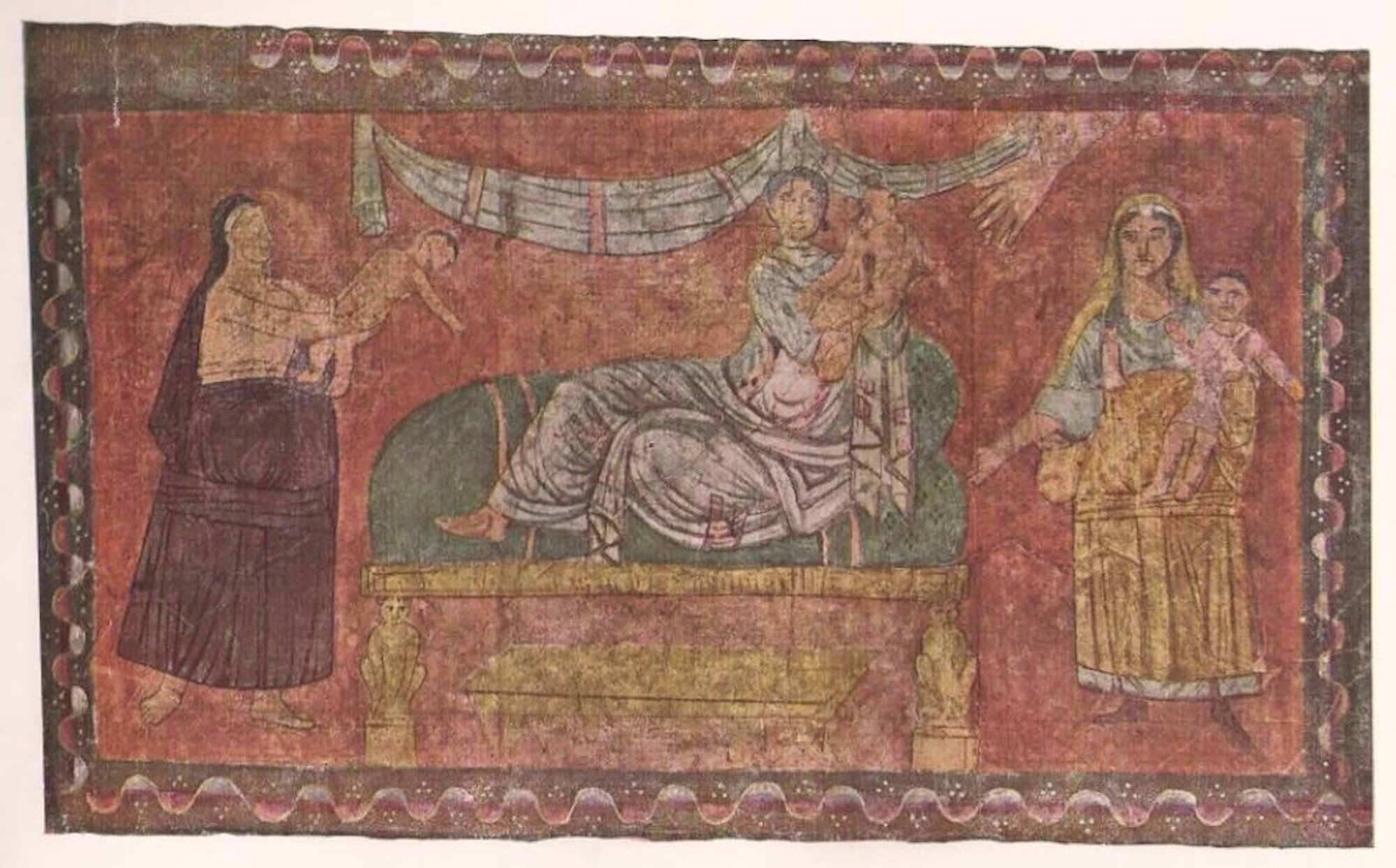
Figure 1: Elijah resurrects the son of the widow of Zarephath, al secco painting, west wall, Dura Europos synagogue, c. 240 CE. Wikimedia Commons, https://commons.wikimedia.org/wiki/File:Elijah_and_widow_of_zarepheth.jpeg.
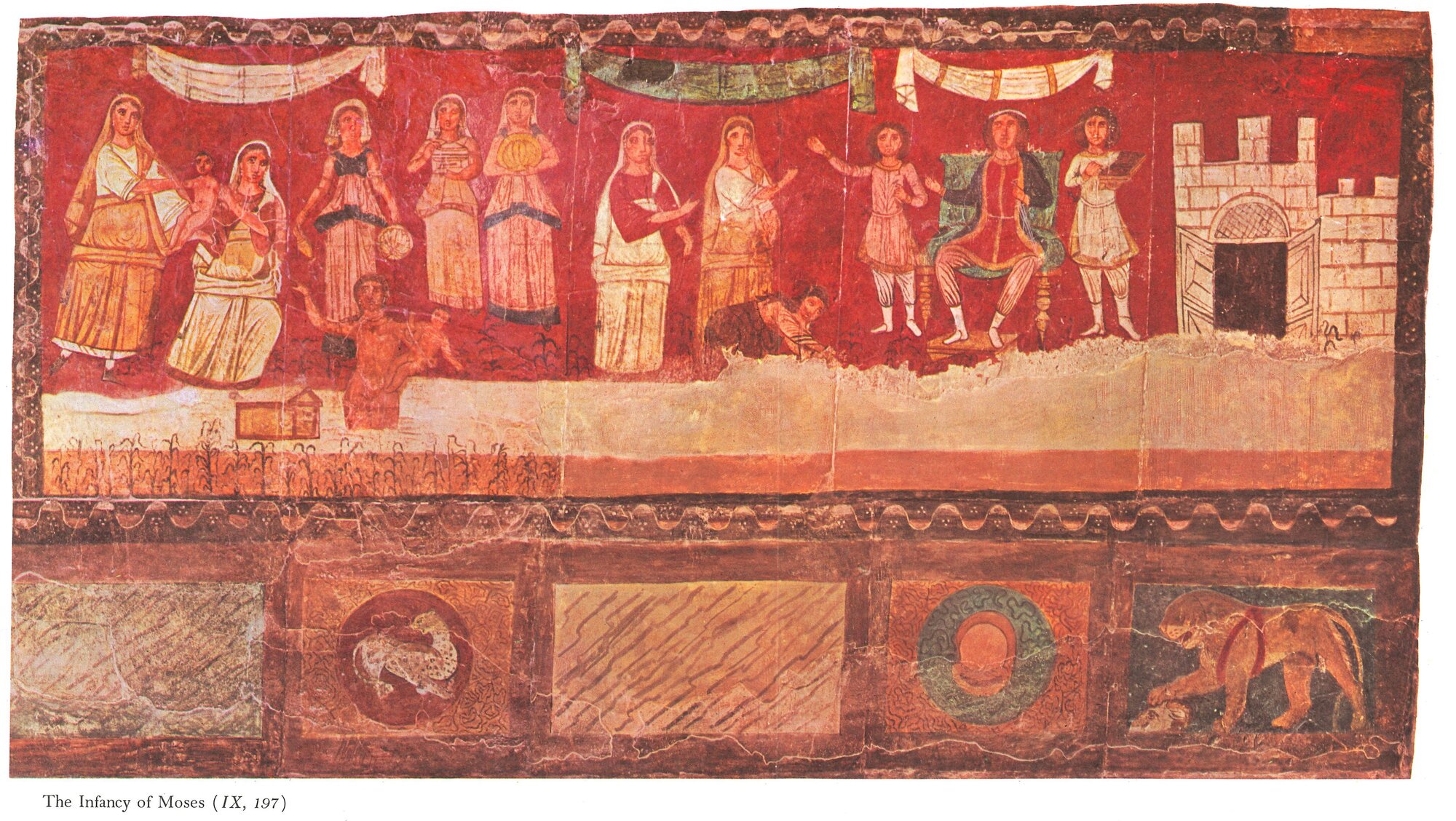
Figure 2: The daughter of Pharaoh rescues Moses from the Nile, al secco painting, west wall, Dura Europos synagogue, c. 240 CE. Wikimedia Commons, https://commons.wikimedia.org/wiki/File:Dura_Europos_fresco_Moses_from_river.jpg.
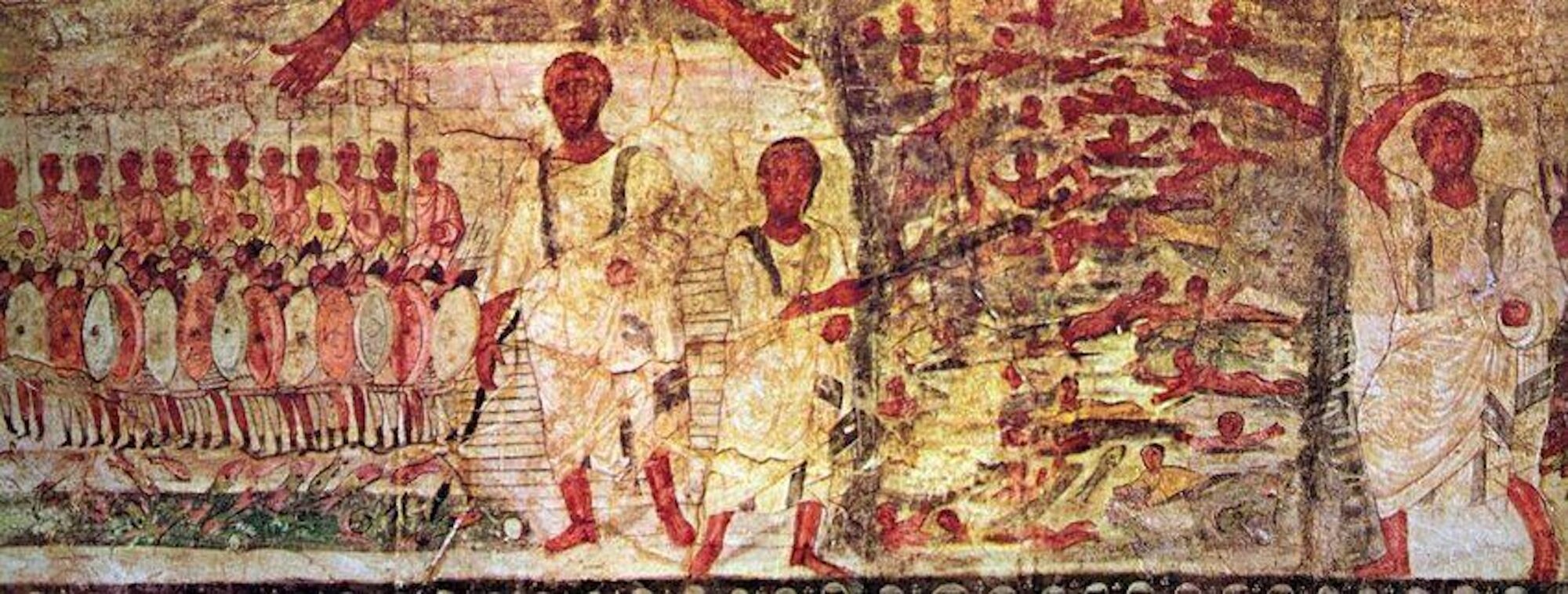
Figure 3: Passage of the Red Sea, al secco painting, west wall, Dura Europos synagogue, c. 240 CE. Wikimedia Commons, https://commons.wikimedia.org/wiki/File:Dura_Europos_fresco_Jews_cross_Red_Sea.jpg.
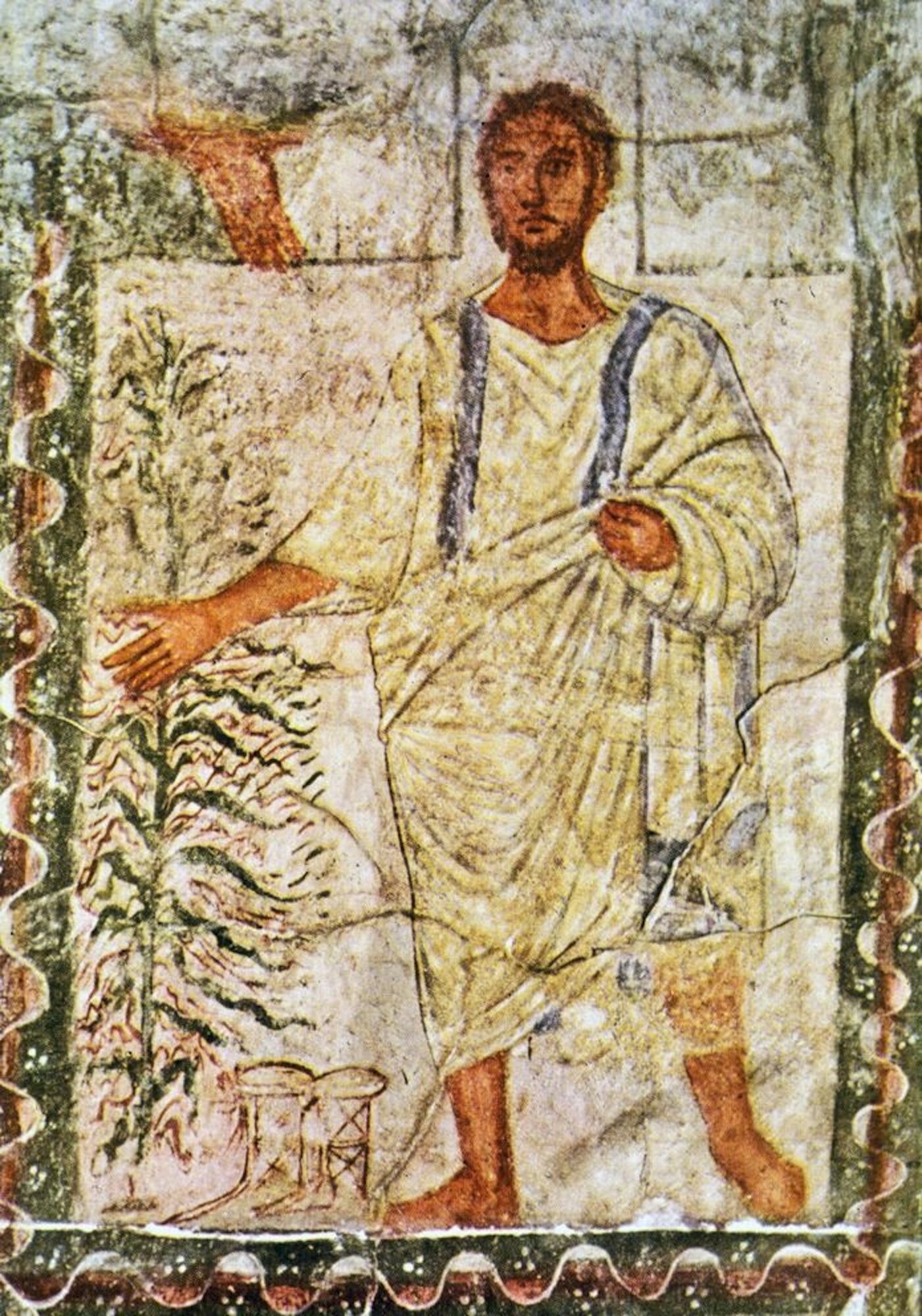
Figure 4: The Burning Bush, al secco painting, west wall, Dura Europos synagogue, c. 240 CE. Wikimedia Commons, https://commons.wikimedia.org/wiki/File:Moses_and_Burning_Bush_Dura_Europos.jpg.
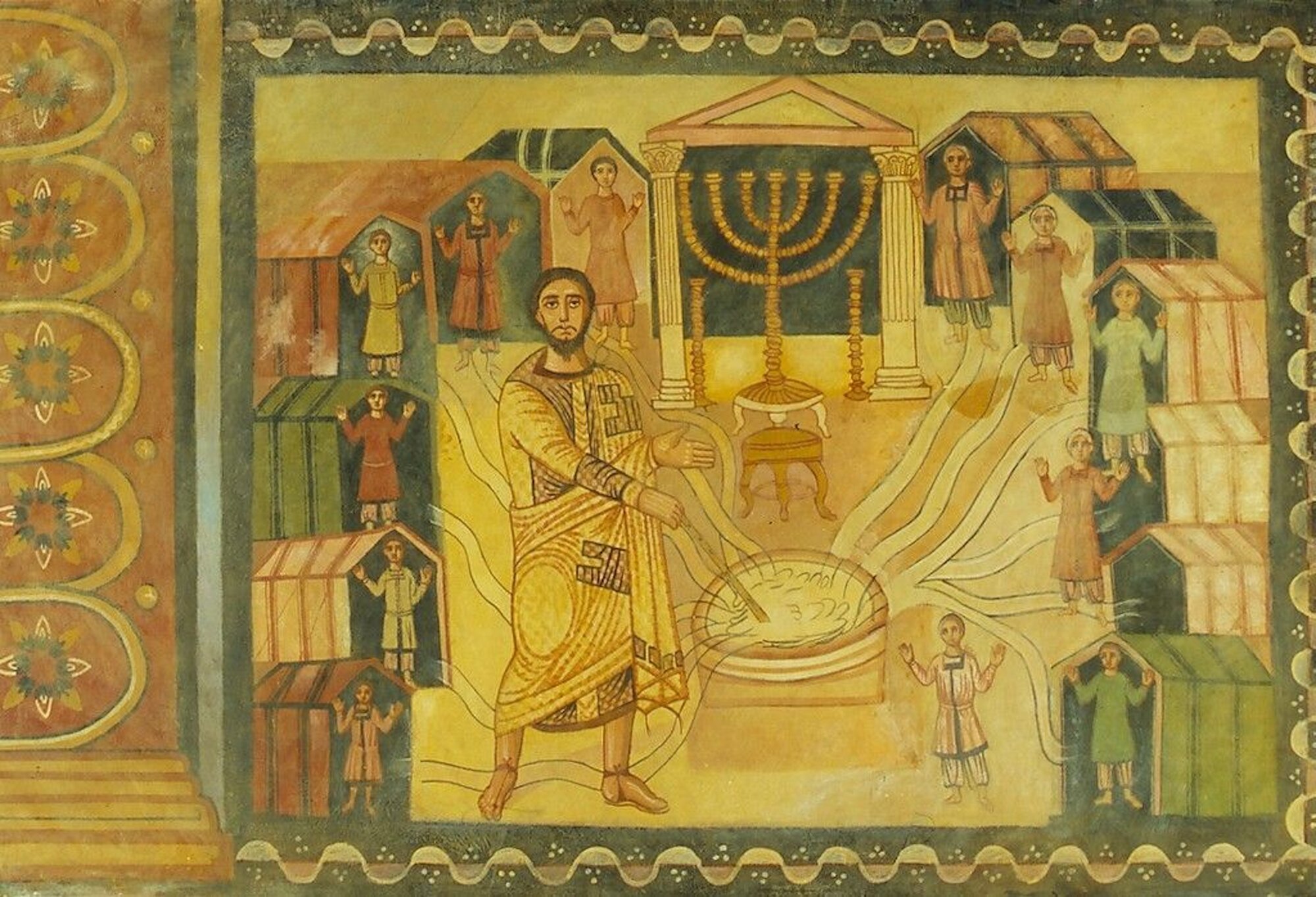
Figure 5: The Twelve sources, watercolor reproduction by Herbert Gute of the al secco painting, west wall, Dura Europos synagogue, c. 240 CE. Wikimedia Commons, https://commons.wikimedia.org/wiki/File:Dura-Europos_archival_photograph,_YUAG_negative_number_dura-ds61~01_-object-id-14190.jpg.
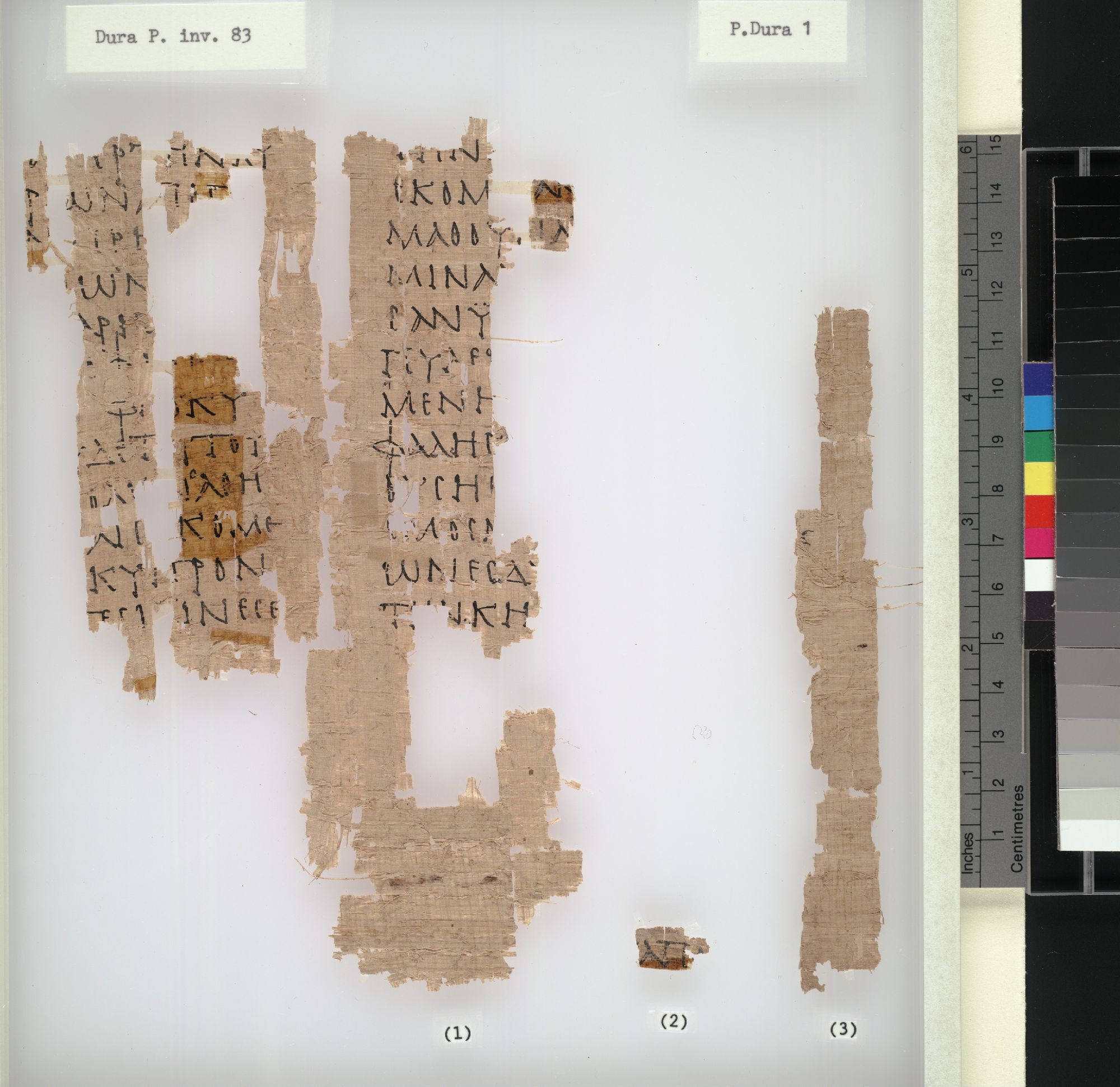
Figure 6: Papyrus of Herodotos from Dura Europos, Beinecke Library, Yale University, P. Dur. 83. https://collections.library.yale.edu/catalog/33191704.
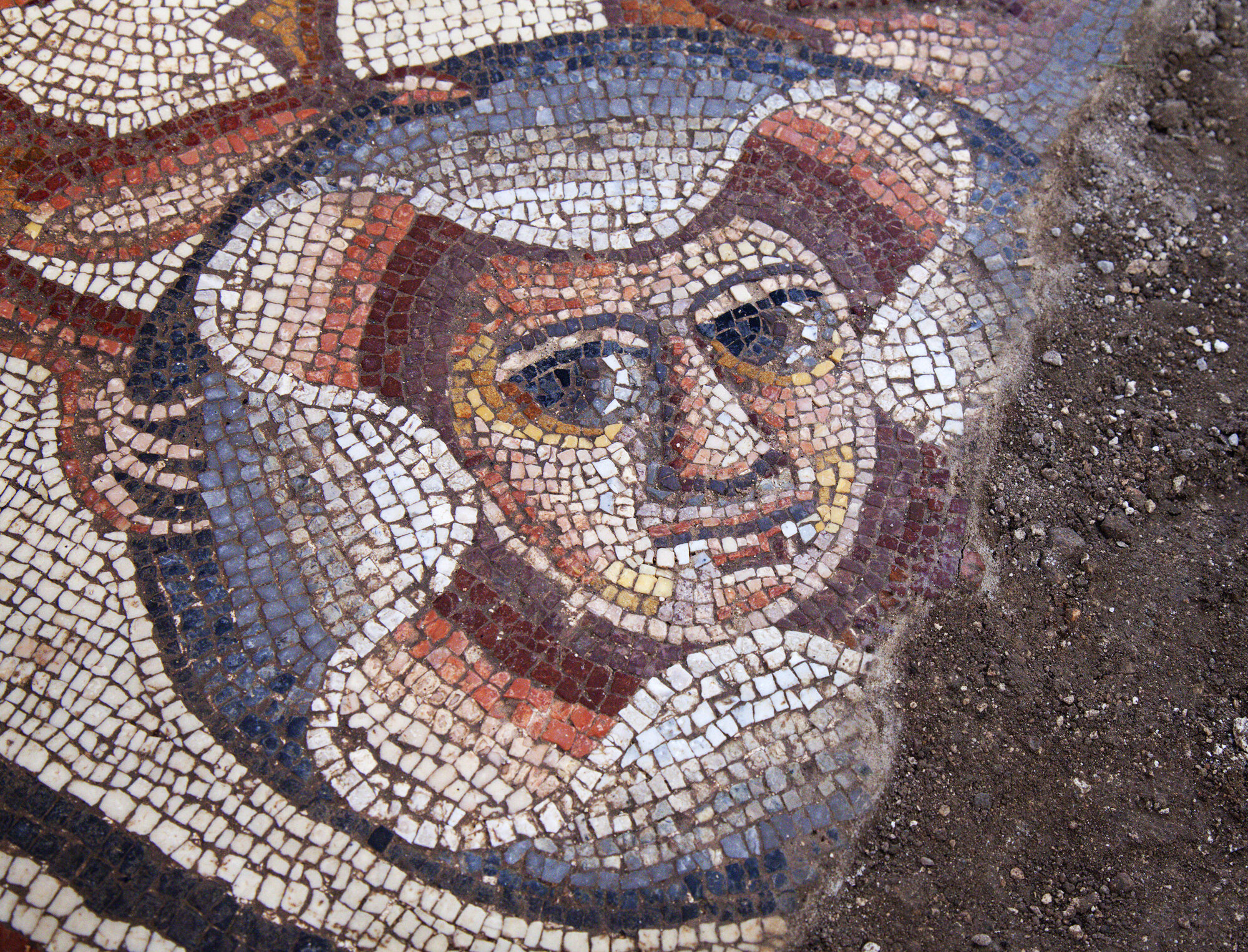
Figure 7: Mosaic mask, Huqoq synagogue. Courtesy of Jodi Magness. Printed by permission.
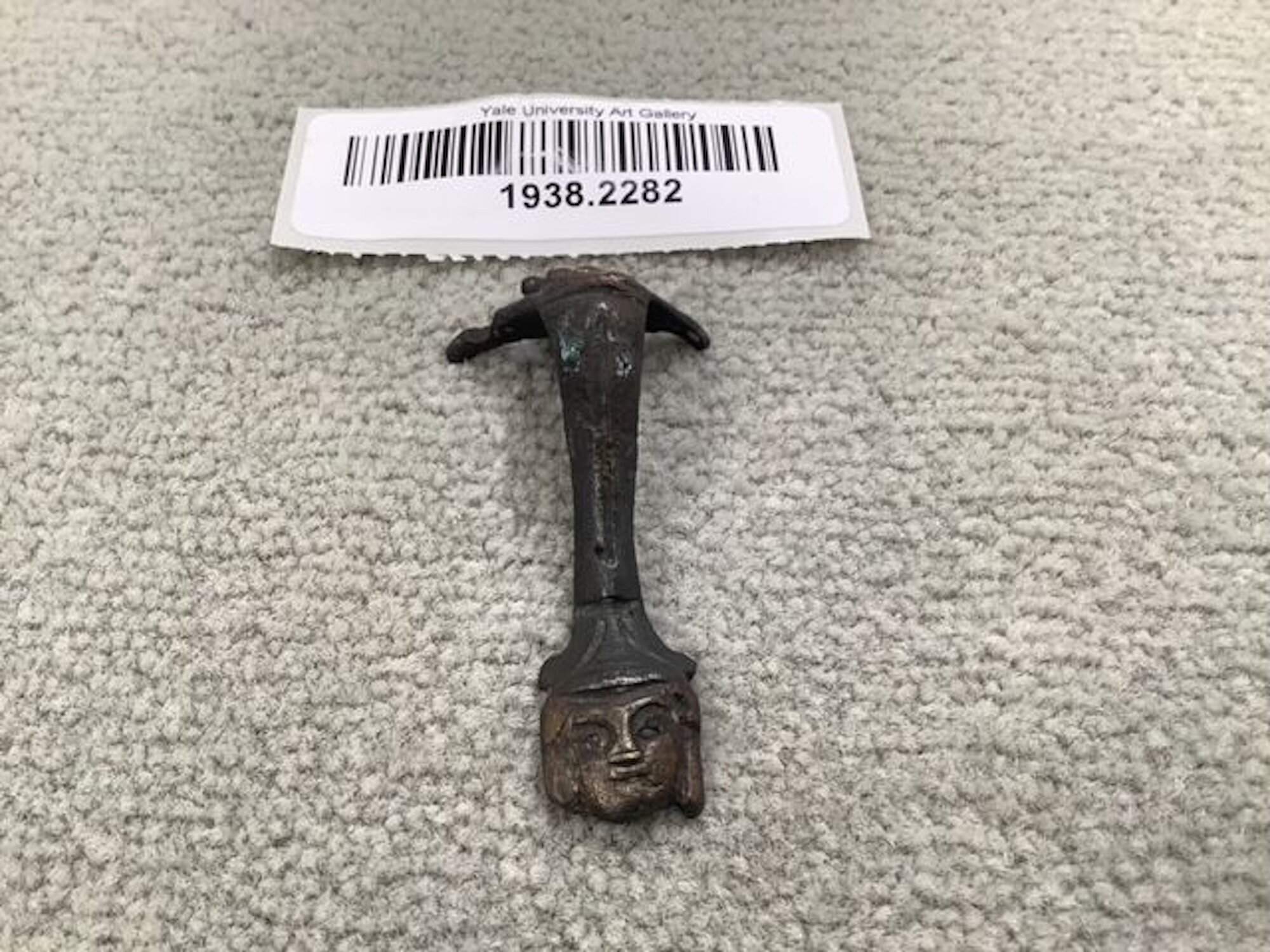
Figure 8: Bronze handle with mask finial, Dura Europos Excavations, Yale University Art Gallery 1938.2282. Photo: Megan Doyon for Barbara Crostini. See also https://artgallery.yale.edu/collections/objects/24618.
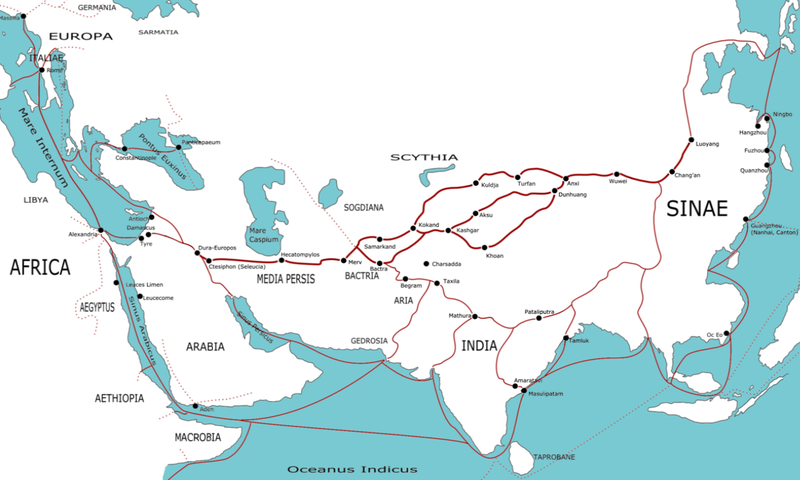
Figure 9: Map of the Silk Road showing Dura Europos. TwoByTwo, CC BY SA. Wikimedia Commons, https://commons.wikimedia.org/wiki/File:Transasia_trade_routes_1stC_CE_gr2.png
Amsler, Monika. “Art and Paradoxography: The Huqoq Synagogue Mosaic.” Studies in Late Antiquity, 10/2 (2026), forthcoming.
Baharal, Drora. Victory of Propaganda: the Dynastic Aspect of the Imperial Propaganda of the Severi: the Literary and Archaeological Evidence AD 193–235. Oxford: Tempus Reparatum, 1996.
Baird, Jennifer. Dura-Europos. London: Bloomsbury, 2018.
Berger, Pamela. “The Temples/Tabernacles in the Dura Synagogue Paintings.” In Dura Europos, Crossroads of Antiquity, edited by Lisa R. Brody and Gail L. Hoffman, 123–40. Chestnut Hill, MA: McMullen Museum of Art, 2011.
Blundell, Sue, Douglas Cairns, Elizabeth Craik and Nancy Sorkin Rabinowitz, “Introduction [to the SI on Vision and Viewing in the Greek World].” Helios 40, no. 1–2 (2013): 3–37.
Bradford Welles, C. “Fragments of Herodotus and Appian from Dura.” Transactions and Proceedings of the American Philological Association 70 (1939): 203–12, pl. I.
Brody, Lisa R. and Gail Hoffman, eds. Dura-Europos: Crossroads of Antiquity. Chestnut Hill, MA: McMullen Museum of Art, 2011.
Bryant Davies, R. “Reading Ezekiel’s Exagoge: Tragedy, Sacrificial Ritual, and the Midrashic Tradition.” Greek, Roman, and Byzantine Studies 48 (2008): 393–415.
Cooley, Alison. “Septimius Severus: the Augustan Emperor.” In Severan Culture, edited by Simon Swain, Stephen Harrison and Jas Elsner, 385–97. Cambridge: Cambridge University Press, 2007.
Crostini, Barbara. Art and Theatre at Dura Europos: an Intermedial Reading of the Synagogue Paintings (c. 240 CE). London: Anthem Press, forthcoming.
Crostini, Barbara. “Empowering Breasts: Women, Widows, and Prophetesses with Child.” In Motherhood and Breastfeeding in Late Antiquity and Byzantium, edited by Aspasia Skouroumouni and Stavroula Constantinou, 206–27. London: Taylor & Francis.
Crostini, Barbara. “Looking Back for Hope: Patterns of Salvation and Positive Performance in the Synagogue at Dura Europos (3rd century).” In Pursuing Hope in the Premodern World, edited by Oana-Maria Cojocaru and Ville Vuolanto, 117–44. London: Palgrave, 2025.
Crostini, Barbara. “Celebrating the Wonders of Elijah in the Painting Cycle at Dura Europos: A Test-Case for the Oral-Performativity of Images.” In From Prophet to Miracle-Working Saint: Dynamic Approaches to Elijah in Late Ancient and Medieval Cultures, edited by Vlad Bedros, Barbara Crostini, Andrei Dumitrescu and Chana Sacham-Rossby, 91–118. Leiden: Brill, 2025.
Delattre, Charles. “Paradoxographic Discourse on Sources and Fountains: Deconstructing Paradoxes.” In Recognizing Miracles in Antiquity, edited by Maria Gerolemou, 205–23. Berlin/Boston: De Gruyter, 2018.
Dormeyer, Detlev. The New Testament among the Writings of Antiquity. Sheffield: Sheffield Academic, 1998.
Elsner, Jás. “Cultural Resistance and the Visual Image: the Case of Dura Europos.” Classical Philology 96.3 (2001): 269–304.
Fine, Steven. Art and Judaism in the Greco-Roman World: Towards a New Jewish Archeology. Cambridge: Cambridge University Press, 2010.
Fowlkes-Childs, Blair, and Michael Seymour. The World between Empires: Art and Identity in the Ancient Middle East, exh. cat. New York: The Metropolitan Museum of Art, 2019.
Gascou, Jean. “The Papyrology of the Near East.” In The Oxford Handbook of Papyrology, edited by Roger S. Bagnall, 473–94. Oxford: Oxford University Press, 2011.
Frank, Georgia. The Memory of the Eyes: Pilgrims to Living Saints in Christian Late Antiquity. Berkeley: University of California Press, 2000.
Gerolemou, Maria. “In Search of the Miraculous.” In Recognizing Miracles in Antiquity, edited by Maria Gerolemou, ix–xx. Berlin/Boston: De Gruyter, 2018.
Gerolemou, Maria. “Wonder-ful Memories in Herodotus’ Histories.” In Recognizing Miracles in Antiquity, edited by Maria Gerolemou, 133–55. Berlin/Boston: De Gruyter, 2018.
Goodenough, Erwin R. By Light, Light: the Mystic Gospel of Hellenistic Judaism. Amsterdam: Philo Press, 1969.
Goodenough, Erwin R. Jewish Symbols in the Greco-Roman Period, vols 9–11. Kingsport, Tenn.: Pantheon Books, 1964.
Gregory, R.L. Eye and Brain: The Psychology of Seeing. London: Weidenfield and Nicolson, 1977.
Grey, Matthew J., and Chad S. Spigel. “Huqoq in the Late Hellenistic and Early Roman Periods.” In Galilee in the Late Second Temple and Mishnaic Periods, vol. 2: The Archaeological Record from Cities, Towns, and Villages, edited by David A. Fiensy and James Riley Strange, 362–78. Minneapolis: Fortress, 2015.
Gruen, Erich S. Heritage and Hellenism: the Reinvention of Jewish Tradition. Berkeley, CA: University of California Press, 1998.
Gruen, Erich S. “Hellenism and Judaism: Fluid Boundaries.” In “Follow the Wise”: Studies in Jewish History and Culture in Honor of Lee I. Levine, edited by Zeev Weiss, Oded Irshai, Jodi Magness and Seth Schwartz, 53–70. University Park, PA: Penn State University Press, 2010.
Gruen, Erich S., ed. Cultural Identity in the Ancient Mediterranean. Los Angeles, CA: Getty Research Institute, 2011.
Gutmann, Joseph. “The Illustrated Midrash in the Dura Synagogue Paintings: A New Dimension for the Study of Judaism.” Proceedings of the American Academy for Jewish Research 50 (1983): 91–204.
Holladay, C.R. Fragments from Hellenistic Jewish Authors. Vol. II: Poets. Atlanta, GA: Scholars Press, 1989.
Høgel, Christian. “Telling a thauma in Hagiography and Paradoxography.” In Storyworlds in Short Narratives: Approaches to Late Antique and Early Byzantine Tales, edited by Stavroula Constantinou and Andria Andreou, 40–58. Leiden: Brill, 2025.
Jefferson, Lee M. “Miracles and Art.” In The Routledge Handbook of Early Christian Art, edited by Robin M. Jensen, 380–401. London: Routledge, 2014.
Jensen, Robin M. “The Dura Europos Synagogue, Early-Christian Art, and Religious Life in Dura Europos.” In Jews, Christians and Polytheists in the Ancient Synagogue: Cultural Interaction during the Greco-Roman Period, edited by Steven Fine, 174–89. London: Routledge, 1999.
Kazantzidis, George. “Medicine and the Paradox in the Hippocratic Corpus and Beyond.” In Recognizing Miracles in Antiquity, edited by Maria Gerolemou, 31–62. Berlin/Boston: De Gruyter, 2018.
Kotlińska-Toma, Agnieszka. Hellenistic Tragedy: Texts, Translations and a Critical Survey. London: Bloomsbury, 2015.
Kraeling, Carl H. The Excavations at Dura-Europos conducted by Yale University and the French Academy of Inscriptions and Letters: Final Report VIII, Part I: The Synagogue. New Haven: Yale University Press, 1956.
König, Jason. “Greek Athletics in the Severan Period: Literary Views.” In Severan Culture, edited by Simon Swain, Stephen Harrison and Jas Elsner, 135–45. Cambridge: Cambridge University Press, 2007.
Hachlili, Rachel. “The Dura-Europos Synagogue Wall Paintings: A Question of Origin and Interpretation.” In “Follow the Wise”: Studies in Jewish History and Culture in Honor of Lee I. Levine, edited by Zeev Weiss, Oded Irshai, Jodi Magness and Seth Schwartz, 403–20. University Park: Penn State University Press, 2010.
Laderman, Shulamith. “A New Look at the Second Register of the West Wall of Dura Europos.” Cahiers Archéologiques 45 (1997): 5–18.
Laderman, Shulamith. “Images of the Temple in Jewish Art and their Parallel in Literary Sources.” In Envisioning the Temple: Rolls, Stones, and Symbols, edited by Adolfo Roitman, 96–125. Jerusalem: The Israel Museum, 2003.
Lanfranchi, Pierluigi. L’Exagoge d’Ezéchiel le Tragique. Leiden: Brill, 2006.
Lanfranchi, Pierluigi. “The Exagoge of Ezekiel the Tragedian.” In Greek Tragedy After the Fifth Century. A Survey from ca. 400 BC to ca. AD 400, edited by Vayos Liapis and Antonis K. Petrides, 125–46. Cambridge: Cambridge University Press, 2019.
Leibner, Uzi, and Catherine Hezser, eds. Jewish Art in Its Late Antique Context. Tübingen: Mohr Siebeck, 2016.
Leibner, Uzi. Settlement and History in Hellenistic, Roman, and Byzantine Galilee: an Archaeological Survey of the Eastern Galilee. Tübingen: Mohr Siebeck, 2009.
Levine, Lee I. Judaism and Hellenism in Antiquity: Conflict or Confluence? Washington, OR: University of Washington Press, 1998.
Levine, Lee I. Visual Judaism in Late Antiquity: Historical Contexts of Jewish Art. New Haven: Yale University Press, 2016.
Ley, Graham. “A Material World: Costume, Properties and Scenic Effects.” In The Cambridge Companion to Greek and Roman Theatre, edited by Marianne McDonald and J. Michael Walton, 268–85. Cambridge: Cambridge University Press, 2007.
Leyra, Irene Pajón. “Turning Science into Miracle in the Voyage of Alexander the Great.” In Recognizing Miracles in Antiquity, edited by Maria Gerolemou, 275–304. Berlin/Boston: De Gruyter, 2018.
Lightfoot, Jessica. Wonder and the Marvellous from Homer to the Hellenistic World. Cambridge: Cambridge University Press, 2021.
Lissovsky, Nurit and Nadav Na’aman. “A New Outlook at the Boundary System of the Twelve Tribes.” Ugarit Forschungen 35 (2003): 291–332.
Lissovsky, Nurit. “Hukkok, Yaquq and Habakkuk’s Tomb: Changes over Time and Space.” Palestine Exploration Quarterly 140, no. 2 (2008): 1013–18.
Mantel, H.D. “The Sadducees and the Pharisees.” In The World History of the Jewish People. Ser. 1, Ancient Times, Vol. 8, Society and Religion in the Second Temple period, edited by Michael Avi-Yonah and Zvi Baras, 99–124. Tel Aviv: Massada Press, 1977.
Mathews, Thomas F. The Clash of Gods: a Reinterpretation of Early Christian Art. Princeton, NJ: Princeton University Press, 1999.
McCourt, Finlay. “An Examination of the Mechanisms of Movement in Heron of Alexandria’s On Automaton-Making.” In Explorations on the History of Machines and Mechanisms, edited by Teun Koetsier and Marco Ceccarelli, 185–98. Dordrecht: Springer Science + Business Media, 2012
Moon, W. G. “Nudity and Narrative: Observations on the Frescoes from the Dura Synagogue.” Journal of the American Academy of Religion 60, no. 1 (1992): 587–658.
Moormann, Eric M. “The Murals of the Synagogue at Dura Europos as an Expression of Roman Koine.” In: Décor 2. Principles of Decoration in the Roman World, edited by Annette Haug and M. Taylor Lauritsen, 141–61. Berlin/Boston: De Gruyter, 2021.
Munson, Rosaria Vignolo. Telling Wonders: Ethnographic and Political Discourse in the Work of Herodotus. Ann Arbor: University of Michigan Press, 2001.
Munson, Rosaria Vignolo. Black Doves Speak: Herodotus and the Languages of Barbarians. Washington, DC: Center for Hellenic Studies, 2005.
ní Mheallaigh, Karen. “Lucian’s Alexander: Technoprophecy, Thaumatology and the Poetics of Wonder.” In Recognizing Miracles in Antiquity, edited by Maria Gerolemou, 225–58. Berlin/Boston: De Gruyter, 2018.
Nilsson, Ingela. “To Render Unbelievable Tales Believable: The Storyworlds of Paradoxography.” In Storyworlds in Short Narratives: Approaches to Late Antique and Early Byzantine Tales, edited by Stavroula Constantinou and Andria Andreou, 59–80. Leiden: Brill, 2025.
Noy, David, and H. Bloedhorn, H. Inscriptiones Judaicae Orientis. Vol. 3: Syria und Cyprus. Tübingen: Mohr Siebeck, 2004.
Paap, A.H.R.E. De Herodoti reliquiis in papyris et membranis Aegyptiis servatis. Papyrologica Lugduno-Batava, IV. Leiden, 1948.
Pack, Roger A. The Greek and Latin Literary Texts from Greco-Roman Egypt. Ann Arbor: University of Michigan Press, 1952.
Potter, D.S. The Roman Empire at Bay AD 180–395. London and New York, 2014.
Prêtre, Clarisse. “The Epidaurian Iamata: The First “Court of Miracles”? In Recognizing Miracles in Antiquity, edited by Maria Gerolemou, 17–30. Berlin/Boston: De Gruyter, 2018.
Priestley, Jessica, Herodotus and Hellenistic Culture: Literary Studies in the Reception of the Histories. Oxford, 2014; online ed., Oxford Academic, 16 Apr. 2014. https://doi.org/10.1093/acprof:oso/9780199653096.001.0001.
Rajak, Tessa. “The Dura Europos Synagogue: Images of a Competitive Community.” In Dura-Europos: Crossroads of Antiquity, edited by Lisa R. Brody and Gail L. Hoffman, 141–54. Chestnut Hill: McMullen Museum of Art, 2011.
Redfield, James. “Herodotus the Tourist.” Classical Philology 80 (1985): 97–118.
Roberts, C.H. The Antinoopolis Papyri. London: Egypt Exploration Society, 1950.
Rostovtzeff, M.I. Caravan Cities. Oxford: Clarendon Press, 1932.
Rowan, Clare. Under Divine Auspices: Divine Ideology and the Visualisation of Imperial Power in the Severan Period. Cambridge: Cambridge University Press, 2012.
Ruffing, Kai. “Economic Life in Roman Dura-Europos.” In Religion, Society and Culture at Dura Europos, edited by Ted Kaizer, 190–98. Cambridge: Cambridge University Press, 2016.
Rutherford, Ian. State Pilgrims and Sacred Observers in Ancient Greece: a Study of Theōriā and Theōroi. Cambridge: Cambridge University Press, 2013.
Rutherford, Ian C. “In a Virtual Wild Space: Pilgrimage and Rite de Passage from Delphi to Sabarimalai.” In Greek Ritual Poetics, edited by Dimitrios Yatromanolakis and Panagiotis Roilos, 323–37. Cambridge, MA and London: Harvard University Press, 2004.
Rutherford, Ian C. “Pilgrimage.” In The Oxford Handbook to the Second Sophistic, edited by Daniel S. Richter, and William A. Johnson, 613–24. Oxford: Oxford University Press, 2017.
Schenk, Kära L. “Temple, Community, and Sacred Narrative in the Dura-Europos Synagogue.” Association for Jewish Studies Review 34.2 (2010): 195–229.
Schlapbach, Karin. “Spectaculum naturae as ʻTheatrical’ Experience: New Uses of an Old Comparison.” Studia Patristica 44 (2010): 421–26.
W. Schubart, Griechische Paläographie. Munich: Beck’sche Verlagsbuchhandlung, 1925.
Schwartz, Daniel R. “Viewing the Holy Utensils (P.Ox. V,849).” New Testament Studies 32 (1986): 153–59.
Smith, Eric C. Jewish Glass and Christian Stone. A Materialist Mapping of the “Parting of the Ways.” London and New York: Routledge, 2018.
Sommer, Michael. “Acculturation, Hybridity, Créolité: Mapping Cultural Diversity in Dura-Europos.” In Religion, Society and Culture at Dura Europos, edited by Ted Kaizer, 57–67. Cambridge: Cambridge University Press, 2016.
Spittler, Janet. “The Development of Miracle Traditions in the Apocryphal Acts of the Apostles.” In Between Canonical and Apocryphal Texts: Processes of Reception, Rewriting and Interpretation in Early Judaism and Early Christianity, edited by Jörg Frey, Claire Clivaz and Tobias Nicklas, 357–79. Tübingen: Mohr Siebeck, 2019.
Stern, Karen B. Writing on the Wall. Graffiti and the Forgotten Jews of Antiquity. Princeton: Princeton University Press, 2018.
Stern, Karen B. “Memory, Postmemory, and Place in the Synagogues of Roman Syria.’ Bulletin of the Institute of Classical Studies 62 (2019): 53–85.
Stern, Karen B. “Touching and Inscribing the Doura-Europos Synagogue.” In Dura Europos, Crossroads of Antiquity, edited by Lisa R. Brody and Gail L. Hoffman, 131–47. Chestnut Hill, MA: McMullen Museum of Art, 2011.
Talgam, Rina. Mosaics of Faith: Floors of Pagans, Jews, Samaritans, Christians, and Muslims in the Holy Land. Jerusalem: Yad Ben-Zvi Press, 2014.
Weitzmann, Kurt and Herbert L. Kessler. The Frescoes of the Dura Synagogue and Christian Art. Washington DC: Dumbarton Oaks, 1990.
Weitzmann, Kurt. Illustrations in Roll and Codex: a Study of the Origin and Method of Text Illustration. Princeton: Princeton University Press, 1970.
Welles, C. Bradford et al. The Excavations at Dura-Europos conducted by Yale University and the French Academy of Inscriptions and Letters: Final Report V, Part I: The Parchments and Papyri. New Haven: Yale University Press, 1959.
Wharton, Annabel. Refiguring the Post Classical City: Dura Europos, Jerash, Jerusalem and Ravenna. Cambridge: Cambridge University Press, 1995.
Wischnitzer, Rachel. The Messianic Theme in the Paintings of the Dura Synagogue. Chicago, IL: University of Chicago Press, 1948.
Xeravits, Géza G. “The Message of the West Wall of the Dura Synagogue.” Zeitschrift der Deutschen Morgenländischen Gesellschaft 167.1 (2017): 111–25.


